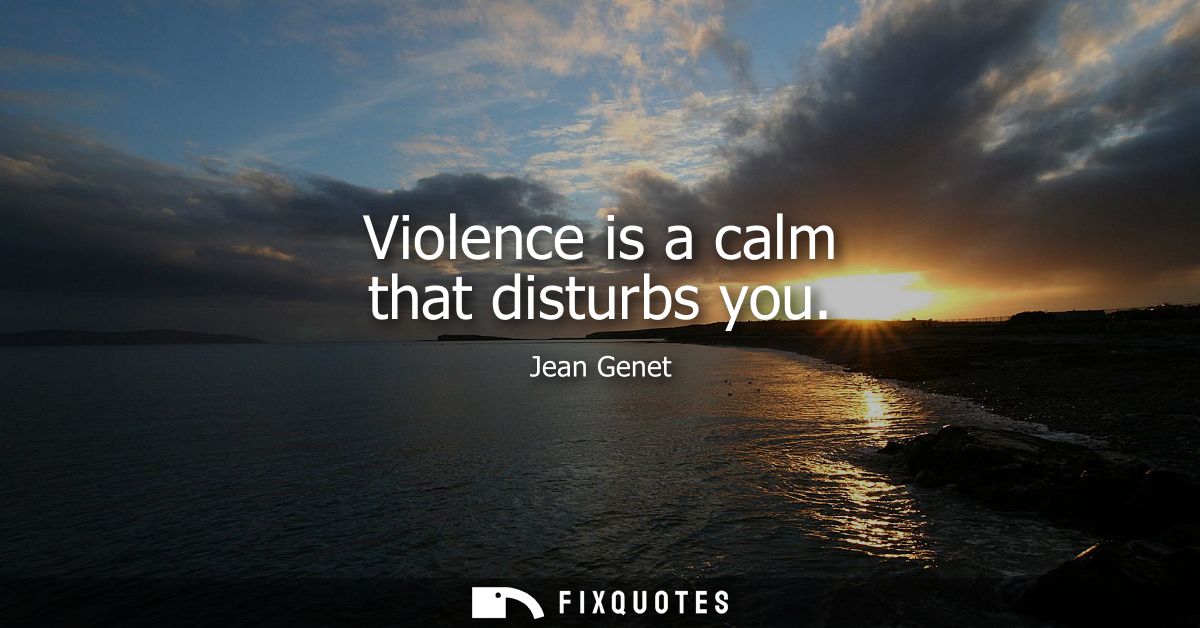
"Violence is a calm that disturbs you"
About this Quote
“Violence is a calm that disturbs you” lands like a whispered threat: the unnerving part isn’t the noise, it’s the composure. Genet flips the usual grammar of violence - chaos, frenzy, loss of control - and replaces it with stillness. That’s not a semantic trick; it’s a moral provocation. The most frightening violence, he suggests, is the kind that doesn’t need to shout. It is deliberate, ritualized, almost serene in its certainty. The disturbance happens in the witness, not in the perpetrator.
This is Genet’s signature territory as a dramatist: turning the audience’s instincts against itself. His theater is stocked with criminals, outcasts, and staged transgressions that expose how “order” often depends on invisible brutality. Calling violence a “calm” hints at its institutional forms - policing, punishment, colonial power - the kinds that wear uniforms, keep paperwork, and maintain an unruffled tone while breaking bodies and lives. The calm is the alibi.
Subtextually, Genet is also indicting our appetite for spectacle. We’re trained to recognize violence when it’s loud, cinematic, and emotionally messy; we miss it when it arrives as procedure, as certainty, as “just doing my job.” That’s why the line works: it makes the reader feel complicit in misrecognition. If violence can be calm, then disturbance becomes the only honest response - a nervous system refusing to normalize what society has already made smooth.
This is Genet’s signature territory as a dramatist: turning the audience’s instincts against itself. His theater is stocked with criminals, outcasts, and staged transgressions that expose how “order” often depends on invisible brutality. Calling violence a “calm” hints at its institutional forms - policing, punishment, colonial power - the kinds that wear uniforms, keep paperwork, and maintain an unruffled tone while breaking bodies and lives. The calm is the alibi.
Subtextually, Genet is also indicting our appetite for spectacle. We’re trained to recognize violence when it’s loud, cinematic, and emotionally messy; we miss it when it arrives as procedure, as certainty, as “just doing my job.” That’s why the line works: it makes the reader feel complicit in misrecognition. If violence can be calm, then disturbance becomes the only honest response - a nervous system refusing to normalize what society has already made smooth.
Quote Details
| Topic | Deep |
|---|
More Quotes by Jean
Add to List