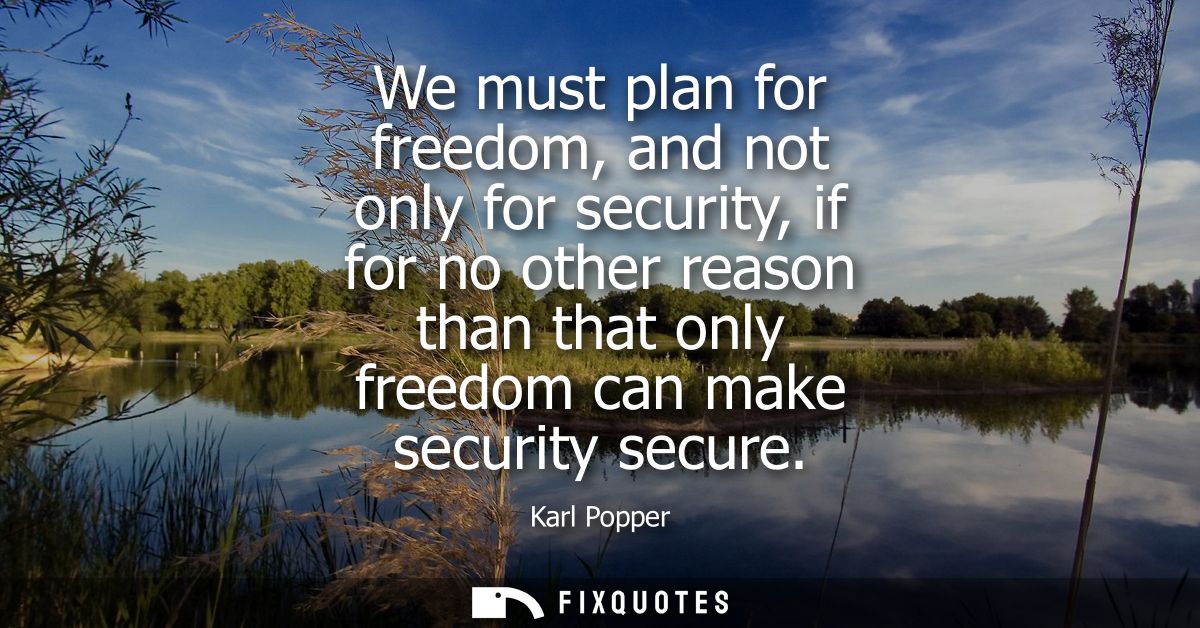
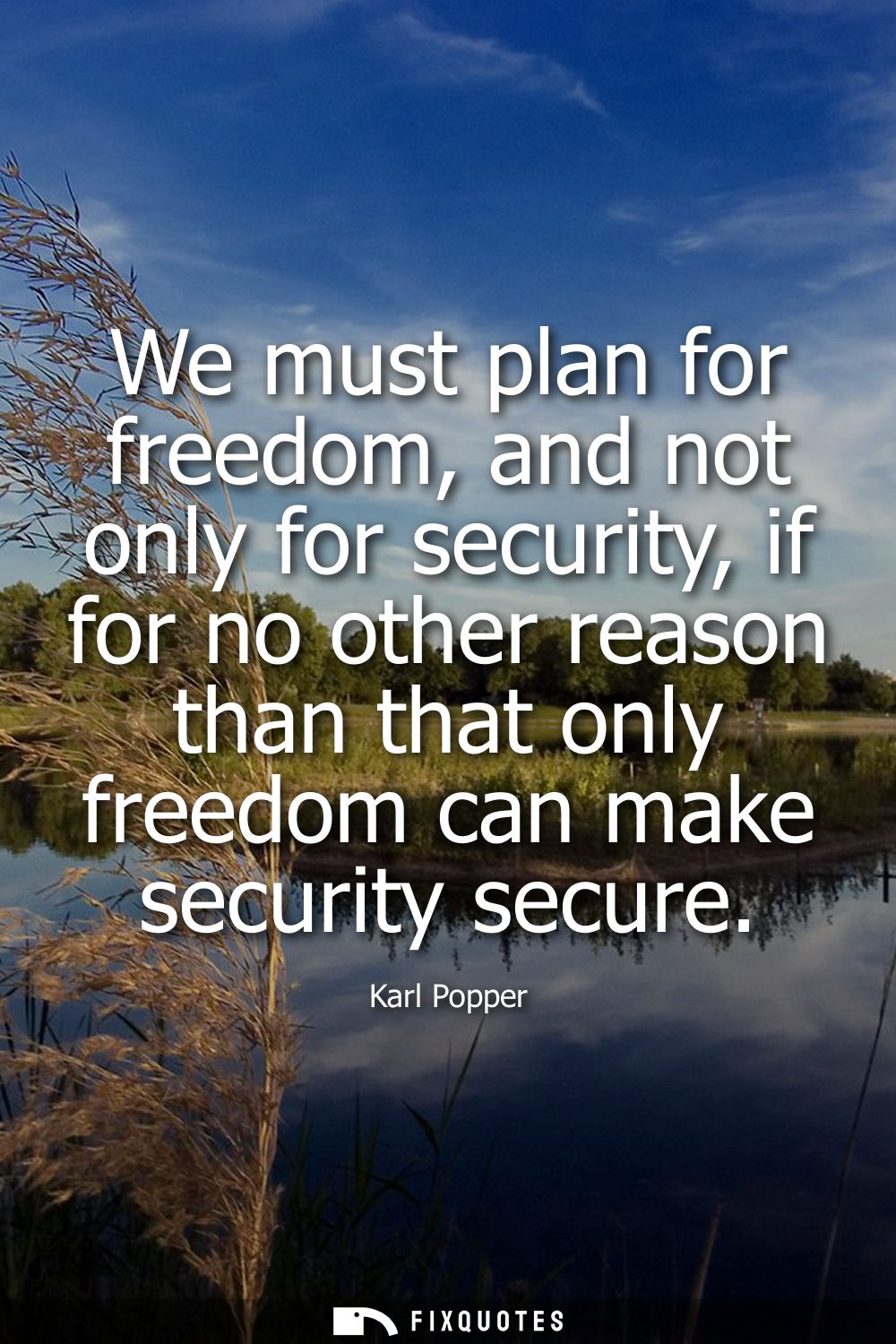
"We must plan for freedom, and not only for security, if for no other reason than that only freedom can make security secure"
About this Quote
Popper’s line is a neat booby trap for the politics of “safety first.” It flips the usual promise of modern states: give us a little more power now and we’ll give you stability later. His syntax does the work of the argument. “Plan for freedom” treats liberty not as a sentimental add-on, but as infrastructure: something designed, maintained, and protected through institutions. Then he undercuts the security frame with that sly, almost tautological kicker: “only freedom can make security secure.” If your security depends on unaccountable authority, it’s not security; it’s a hostage situation with better branding.
The subtext is Popper’s lifelong fight with political systems that claim historical necessity and demand obedience in exchange for order. Writing in the shadow of fascism and communism, he had watched “security” become the all-purpose excuse for censorship, surveillance, purges, and the elimination of opposition. His broader project in The Open Society and Its Enemies is to defend “piecemeal social engineering” over utopian blueprints: reform that can be criticized, reversed, and improved. That’s what “freedom” really names here: the capacity for error-correction.
Contextually, Popper is also diagnosing a psychological weakness in democracies. Fear makes citizens trade durable safeguards (speech, dissent, legal constraints) for short-term reassurance. Popper warns that this bargain corrodes the very conditions that keep power from turning predatory. Freedom isn’t the enemy of security; it’s the mechanism that keeps security from mutating into its opposite.
The subtext is Popper’s lifelong fight with political systems that claim historical necessity and demand obedience in exchange for order. Writing in the shadow of fascism and communism, he had watched “security” become the all-purpose excuse for censorship, surveillance, purges, and the elimination of opposition. His broader project in The Open Society and Its Enemies is to defend “piecemeal social engineering” over utopian blueprints: reform that can be criticized, reversed, and improved. That’s what “freedom” really names here: the capacity for error-correction.
Contextually, Popper is also diagnosing a psychological weakness in democracies. Fear makes citizens trade durable safeguards (speech, dissent, legal constraints) for short-term reassurance. Popper warns that this bargain corrodes the very conditions that keep power from turning predatory. Freedom isn’t the enemy of security; it’s the mechanism that keeps security from mutating into its opposite.
Quote Details
| Topic | Freedom |
|---|
More Quotes by Karl
Add to List