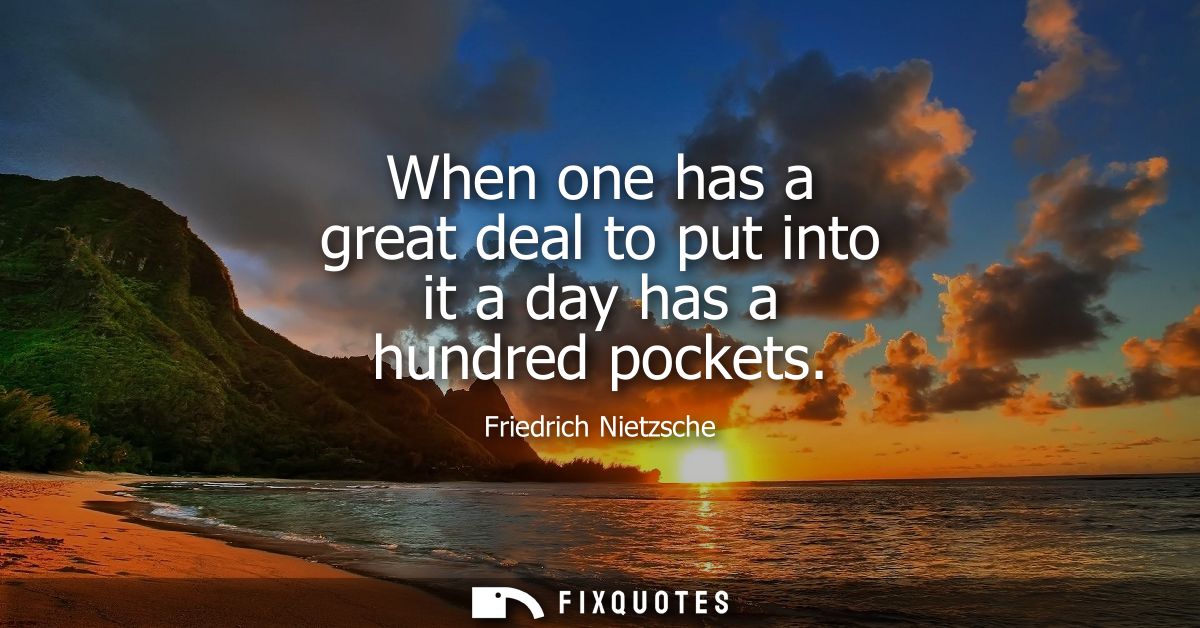
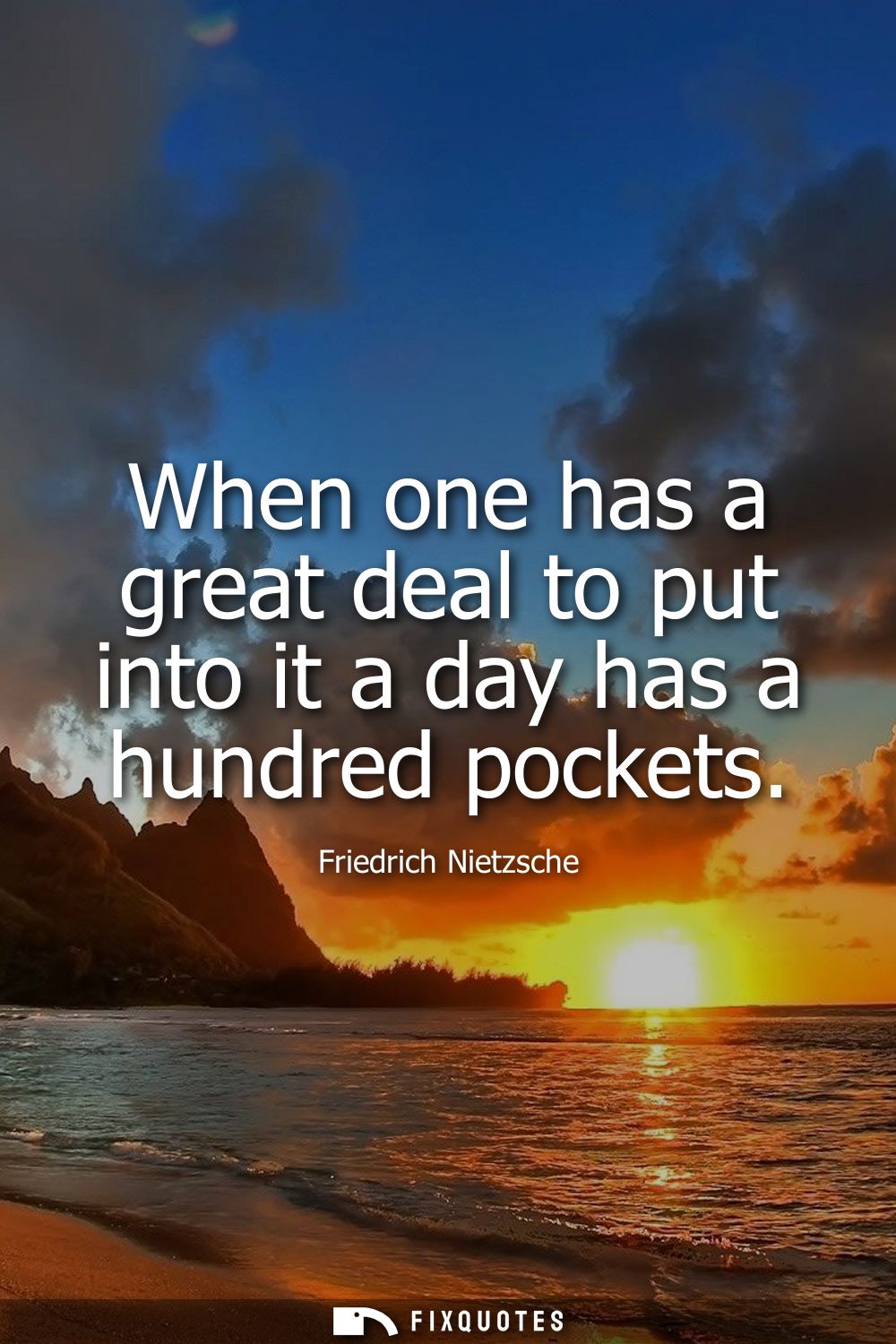
"When one has a great deal to put into it a day has a hundred pockets"
About this Quote
The subtext is characteristically Nietzschean: value is not found but made. A “day” is not meaningful by default; it becomes meaningful when a strong will organizes it, when one imposes form on the formless. The pockets aren’t handed out by fate. They appear for the person capable of filling them. That’s both empowering and accusatory, the way Nietzsche likes it. It flatters the creator and indicts the drifter.
Context matters: Nietzsche is writing in a 19th-century Europe newly disciplined by clocks, factories, and bourgeois respectability, while he himself lives against the grain - itinerant, ill, working in intense bursts. The metaphor reads like a private survival technique elevated into philosophy: if your body limits you, your intensity has to out-invent limitation. “A hundred pockets” isn’t productivity-hustle; it’s a theory of lived abundance, where time feels larger when your inner life is larger.
Quote Details
| Topic | Time |
|---|---|
| Source | Help us find the source |
| Cite |
Citation Formats
APA Style (7th ed.)
Nietzsche, Friedrich. (2026, January 14). When one has a great deal to put into it a day has a hundred pockets. FixQuotes. https://fixquotes.com/quotes/when-one-has-a-great-deal-to-put-into-it-a-day-34560/
Chicago Style
Nietzsche, Friedrich. "When one has a great deal to put into it a day has a hundred pockets." FixQuotes. January 14, 2026. https://fixquotes.com/quotes/when-one-has-a-great-deal-to-put-into-it-a-day-34560/.
MLA Style (9th ed.)
"When one has a great deal to put into it a day has a hundred pockets." FixQuotes, 14 Jan. 2026, https://fixquotes.com/quotes/when-one-has-a-great-deal-to-put-into-it-a-day-34560/. Accessed 5 Feb. 2026.