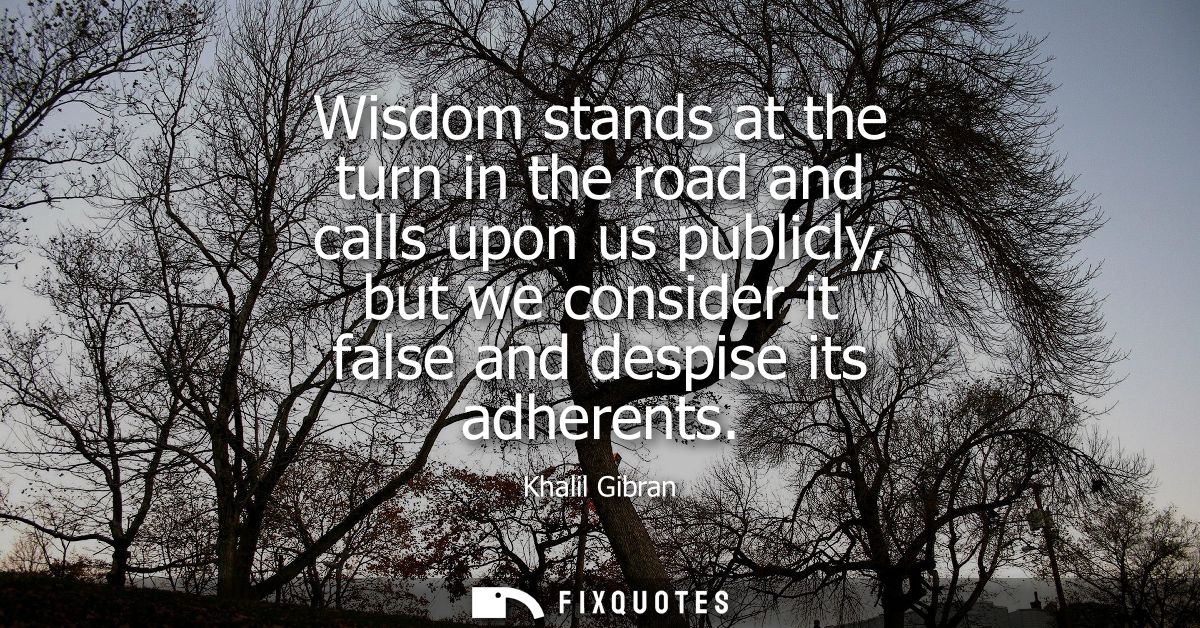
"Wisdom stands at the turn in the road and calls upon us publicly, but we consider it false and despise its adherents"
About this Quote
Gibran casts wisdom not as some shy, private insight but as a street-corner prophet: visible, audible, and inconvenient. “Stands at the turn in the road” is the key image. A turn is decision, rupture, the moment when momentum can no longer carry you. Wisdom arrives precisely there, where habit loses its authority and a person has to choose. The bite is in “calls upon us publicly.” Wisdom isn’t merely available; it recruits, and it does so in full view of others. That publicness raises the stakes: accepting wisdom risks embarrassment, loss of status, and the humiliation of changing your mind where people can see.
The subtext is social. “We consider it false and despise its adherents” doesn’t describe an innocent misunderstanding; it sketches a community’s defense mechanism. If wisdom threatens a shared delusion, the group can’t just ignore it. It has to delegitimize it and, crucially, punish the people who listen. “Adherents” makes wisdom sound like a creed, suggesting that even practical insight gets treated like a factional identity: you’re not right, you’re one of them.
In Gibran’s era - shaped by modernity’s churn, nationalism, and the immigrant’s double vision - the line reads as a critique of crowds that fear moral clarity because it disrupts belonging. Wisdom becomes scandalous not because it’s obscure, but because it’s plain, demanding, and socially costly.
The subtext is social. “We consider it false and despise its adherents” doesn’t describe an innocent misunderstanding; it sketches a community’s defense mechanism. If wisdom threatens a shared delusion, the group can’t just ignore it. It has to delegitimize it and, crucially, punish the people who listen. “Adherents” makes wisdom sound like a creed, suggesting that even practical insight gets treated like a factional identity: you’re not right, you’re one of them.
In Gibran’s era - shaped by modernity’s churn, nationalism, and the immigrant’s double vision - the line reads as a critique of crowds that fear moral clarity because it disrupts belonging. Wisdom becomes scandalous not because it’s obscure, but because it’s plain, demanding, and socially costly.
Quote Details
| Topic | Wisdom |
|---|
More Quotes by Kahlil
Add to List