
Agnes Repplier Biography Quotes 22 Report mistakes
| 22 Quotes | |
| Occup. | Writer |
| From | USA |
| Born | April 1, 1855 Philadelphia, Pennsylvania, USA |
| Died | November 15, 1950 Philadelphia, Pennsylvania, USA |
| Aged | 95 years |
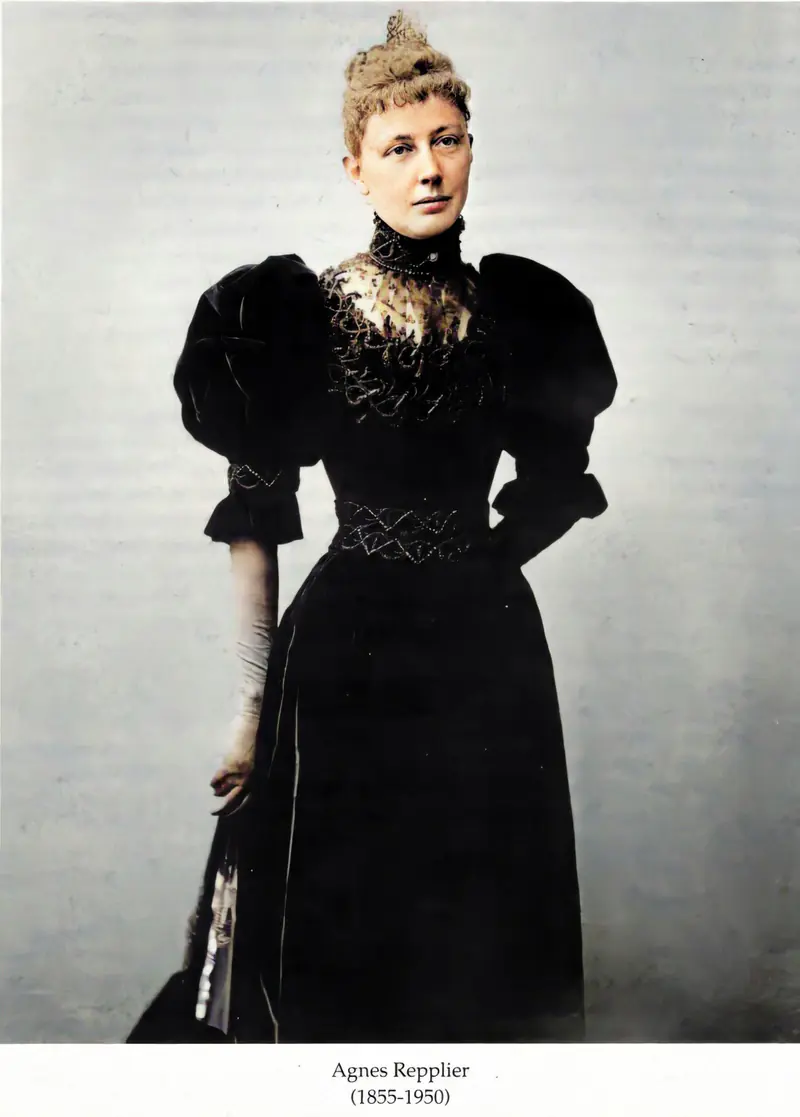
Agnes Repplier was born on April 1, 1855, in Philadelphia, Pennsylvania, into a Catholic family whose loyalties were shaped by the shock waves of European politics and American nativism. Her father, a physician with strong Southern sympathies during the Civil War, died when she was young; her mother, a resourceful widow, became the steady hand that held the household together. In an era when Catholic Philadelphia still carried the memory of anti-immigrant riots and social exclusion, Repplier grew up alert to the ways respectable opinion could turn provincial, and how style and intellect could serve as a passport across boundaries.
Philadelphia mattered to her - the city of libraries, lectures, parlor conversation, and stubborn traditions - and it lent her a lifelong fascination with manners, leisure, and moral postures. Yet she was never merely local. The nineteenth century was expanding the American reading public through magazines and syndication, and Repplier would eventually thrive in that world: private by temperament, public through print, and drawn to the intricate comedy of human self-importance.
Education and Formative Influences
Educated primarily at home and in Catholic schools, Repplier absorbed the disciplines of Latin, history, and devotional reading while also ranging widely through English prose and French memoir. The Catholic intellectual tradition offered her both a moral vocabulary and an outsider's vantage point on American respectability; the essayists she loved taught her that wit could be a form of conscience. Without a university career or salon of her own, she made the page her academy, cultivating a voice that combined urbane amusement with a historian's appetite for context.
Career, Major Works, and Turning Points
Repplier built her reputation from the 1880s onward as a major American essayist, publishing in leading periodicals and collecting her work in volumes that showcased her gifts for moral portraiture and cultural criticism. Books such as Essays in Idleness, Points of View, In Our Convent Days, and The Fireside Sphinx refined her signature approach: erudition worn lightly, laughter used as a lens, and a steady refusal to flatter fashionable certainties. As she matured, she also wrote literary biography and historical studies, including a notable life of Charles Lamb, demonstrating that her wit was anchored in close reading and archival patience. Honors followed - among them election as the first woman recipient of the University of Notre Dame's Laetare Medal (1925) - but she kept her independence, preferring the authority of an unbought sentence to the comforts of a fixed ideology.
Philosophy, Style, and Themes
Repplier's inner life is best approached through what she found ridiculous and what she refused to sentimentalize. She believed that humor was not a decorative talent but a moral instrument: "Humor distorts nothing, and only false gods are laughed off their earthly pedestals". The line reveals her psychological posture - skeptical of cant, allergic to idol-making, and convinced that clear laughter can be a kind of truth-telling. Her essays repeatedly probe the social machinery of opinion, the way earnestness can become a mask, and the way public virtue can slide into performance.
At the same time, she distrusted the complacent mind as an obstacle to culture. "People who cannot recognize a palpable absurdity are very much in the way of civilization". In Repplier's hands, that is not a mere epigram but a diagnosis: the inability to see absurdity signals an inability to see oneself. Yet she was not a cynic. Beneath her irony runs a quietly Augustinian sense of the heart's responsibilities and limits, summed in her bracing admission that contentment is an inward discipline: "It is not easy to find happiness in ourselves, and it is not possible to find it elsewhere". Her style - poised, allusive, lightly barbed - belongs to the great Anglo-American essay tradition, but her themes are deeply modern: the fragility of attention, the politics of culture, the moral cost of fashionable certainty, and the consolation of books when public life grows shrill.
Legacy and Influence
Repplier lived long enough to see the magazine age that made her fame yield to new literary fashions; she died in Philadelphia on November 15, 1950. Yet her influence persists in the American essay as a form of intellectual character - a model of how to be learned without pedantry, witty without cruelty, and moral without hectoring. For later critics, Catholic writers, and general readers, she remains a bracing example of independent mind in a crowded public sphere, reminding the modern essayist that amusement can be a discipline and that style, rightly used, is a way of thinking in public without surrendering the self.
Our collection contains 22 quotes who is written by Agnes, under the main topics: Witty One-Liners - Wisdom - Truth - Justice - Love.
Agnes Repplier Famous Works
- 1916 Counter-Currents (Book)
- 1912 Americans and Others (Book)
- 1908 The Cat: A Calendar and Anthology (Book)
- 1905 In Our Convent Days (Book)
- 1901 The Fireside Sphinx (Book)
- 1898 Philadelphia: The Place and the People (Book)
- 1897 Varia (Book)
- 1894 In the Dozy Hours, and Other Papers (Book)
- 1892 A Book of Famous Verse (Book)
- 1892 Essays in Miniature (Book)
- 1891 Points of View (Book)
- 1888 Books and Men (Book)
Source / external links