
Jefferson Davis Biography Quotes 5 Report mistakes
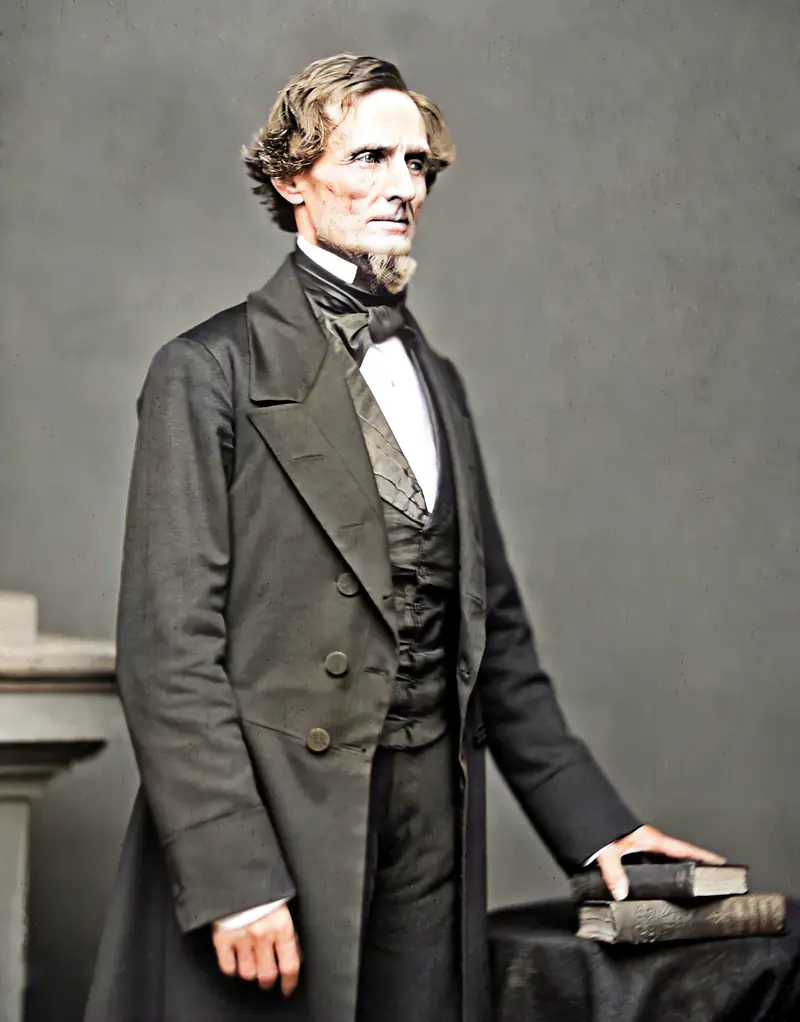
Attr: Mathew Benjamin Brady, Public domain
| 5 Quotes | |
| Born as | Jefferson Finis Davis |
| Occup. | President |
| From | USA |
| Spouse | Varina Howell Davis |
| Born | June 3, 1808 Fairview, Kentucky, USA |
| Died | December 6, 1889 New Orleans, Louisiana, USA |
| Cause | Heart failure |
| Aged | 81 years |
Jefferson Finis Davis was born on June 3, 1808, in Christian County, Kentucky (an area later partitioned into Todd County). He was the youngest of ten children of Samuel Emory Davis and Jane Cook Davis, a family that moved south and west with the early American frontier. Raised primarily in Mississippi, he attended local schools before studying at Transylvania University in Kentucky. In 1824 he received an appointment to the United States Military Academy at West Point, where he completed his studies in 1828 and received a commission in the U.S. Army.
Army Service and First Marriage
As a junior officer, Davis served at frontier posts in the upper Midwest and participated in the Black Hawk War of 1832. Stationed at Fort Crawford, he came under the command of Colonel Zachary Taylor, a relationship that later shaped both his personal and public life. In 1835 he married Taylor's daughter, Sarah Knox Taylor. The young couple soon fell ill with malaria while visiting family near the lower Mississippi; Sarah died only months after their wedding. Deeply affected, Davis resigned from the Army that same year and retired to Brierfield, a plantation on the Mississippi River he developed near his brother Joseph E. Davis's Hurricane Plantation. There he studied law, managed enslaved laborers, and reentered civic life in his adopted state.
Entry into Politics and Second Marriage
Davis emerged as a Democratic spokesman for states' rights and territorial expansion. In 1845 Mississippi voters elected him to the U.S. House of Representatives. That same year he married Varina Howell of Natchez, whose intellect and writing would play a lasting role in shaping public perceptions of her husband. Varina Howell Davis maintained a wide correspondence and later wrote vividly about the political figures around them, including senators, cabinet members, and generals with whom Davis worked and argued.
Mexican-American War and Rise to the Senate
When war with Mexico began, Davis resigned his House seat to command the volunteer 1st Mississippi Rifles. He led his regiment at Monterrey and fought conspicuously at Buena Vista in 1847, where he suffered a wound but gained national attention for resolute leadership. After the war he entered the U.S. Senate from Mississippi. In Washington, he aligned with Southern Democrats, citing the constitutional theories associated with John C. Calhoun, while developing relationships, sometimes collegial, sometimes combative, with figures such as Henry Clay's followers and rising national leaders who would soon dominate the 1850s.
Secretary of War under Franklin Pierce
President Franklin Pierce appointed Davis Secretary of War in 1853. In that post, Davis pursued modernization: he advocated expanding the regular army, supported new weaponry, and oversaw surveys for a transcontinental railroad, favoring southern routes. He backed the Gadsden Purchase and encouraged experimental projects such as the U.S. Army's camel corps. Working closely with cabinet colleagues like Secretary of State William L. Marcy and congressional allies from the South, he sought to strengthen national defenses while preserving a political balance that, in his view, protected slavery and state sovereignty.
Return to the Senate and Secession Crisis
Davis returned to the Senate in 1857 and became a leading Southern voice in the escalating national dispute over slavery's expansion into the territories. He argued for constitutional protections of slave property and states' rights but initially counseled caution about immediate secession. As the 1860 election brought Abraham Lincoln to the presidency and Deep South states moved toward disunion, Davis announced that his ultimate loyalty was to Mississippi. On January 21, 1861, he resigned from the Senate, a farewell witnessed by colleagues who had served alongside him during the volatile 1850s.
President of the Confederate States
In February 1861, delegates at Montgomery, Alabama, chose Davis as provisional president of the Confederate States, with Alexander H. Stephens as vice president. He soon formed a cabinet that included Judah P. Benjamin, Robert Toombs, Christopher Memminger, Stephen Mallory, and John H. Reagan. When Virginia seceded, the Confederate capital moved to Richmond, where Davis was inaugurated for a six-year term in 1862. He attempted to balance national authority with state autonomy, a tension that would define Confederate politics and his own leadership.
War Leadership and Military Relationships
Davis's strategic vision emphasized offensive opportunities despite chronic shortages and the Union's industrial advantage. He maintained close ties with senior commanders, eventually elevating Robert E. Lee to general-in-chief in 1865. Yet his tenure was marked by friction with several generals. He clashed with Joseph E. Johnston over strategy and command responsibilities, quarreled at times with P. G. T. Beauregard, and gave extended backing to Braxton Bragg despite widespread criticism. On the western fronts he faced the relentless pressure of Ulysses S. Grant and William T. Sherman, whose campaigns cut through Confederate territory. In Richmond he wrestled with Congress, governors such as Joseph E. Brown of Georgia, and his own cabinet over conscription, habeas corpus, and economic controls, while Judah P. Benjamin emerged as his most versatile and dependable minister, rotating through key departments.
Collapse of the Confederacy and Capture
By 1864, 1865, battlefield losses, internal strains, and the Union blockade eroded Confederate capacity. After Richmond fell in April 1865, Davis fled south hoping to continue resistance or reach Confederate forces in the Trans-Mississippi. He was captured in Georgia in May 1865. The postwar North debated his culpability and the appropriate punishment. Imprisoned at Fort Monroe, Virginia, he faced indictment for treason but was never brought to trial. His confinement spurred public controversy; over time, Northern figures such as Horace Greeley joined Southern supporters in advocating his release on bail, which occurred in 1867. The government eventually dropped the case in 1869.
Later Years, Writings, and Family
After his release, Davis spent time in Canada and Europe before returning to the South. He served as president of the Carolina Life Insurance Company in Memphis and later resided at Beauvoir on the Mississippi Gulf Coast, where he benefited from the hospitality and support of Sarah Ellis Dorsey, a writer and benefactor. With Varina's help and in conversation with former Confederate leaders and journalists, he completed his two-volume history, The Rise and Fall of the Confederate Government (1881), a work that defended the Confederate cause and contributed to the developing Lost Cause narrative. His circle in these years included Judah P. Benjamin (then in exile in Britain), John H. Reagan, Stephen Mallory, and veterans who worked to shape public memory. Within his family, the Davises suffered multiple bereavements, yet Varina Anne "Winnie" Davis became a symbol to many white Southerners as the so-called "Daughter of the Confederacy".
Death and Legacy
Jefferson Davis died in New Orleans on December 6, 1889. His funeral drew large crowds, and in 1893 his remains were reinterred in Hollywood Cemetery in Richmond, Virginia, near many Confederate dead, including soldiers who had served under Robert E. Lee. Davis's life left a complex legacy. To supporters, he embodied constitutional scruples, personal austerity, and devotion to an embattled region; to critics, he was the leading political advocate for a rebellion organized to preserve slavery. The posthumous restoration of his U.S. citizenship by Congress in 1978 underscored the nation's persistent struggle over Civil War memory. Davis's career remains inseparable from the era's most consequential personalities: Franklin Pierce, with whom he modernized the Army; Zachary Taylor, whose family he joined and later opposed in politics; Abraham Lincoln, against whose government he led the Confederacy; Alexander H. Stephens, Judah P. Benjamin, and Robert E. Lee, who shaped Confederate policy and strategy; and Union commanders such as Ulysses S. Grant and William T. Sherman, whose campaigns ultimately ensured the Confederacy's defeat.
Our collection contains 5 quotes who is written by Jefferson, under the main topics: Truth - Freedom - War - Humility.
Other people realated to Jefferson: Horace Greeley (Editor), James Buchanan (President), Albert Pike (Lawyer), Shelby Foote (Author), Mary Chesnut (Author), Gideon Welles (Soldier), Gerrit Smith (Politician), John B. Hood (Soldier), Judah Philip Benjamin (Politician), Henry A. Wise (Statesman)
Jefferson Davis Famous Works
- 1890 A Short History of the Confederate States of America (Book)
- 1881 The Rise and Fall of the Confederate Government (Book)
Source / external links