
Jorge Luis Borges Biography Quotes 31 Report mistakes
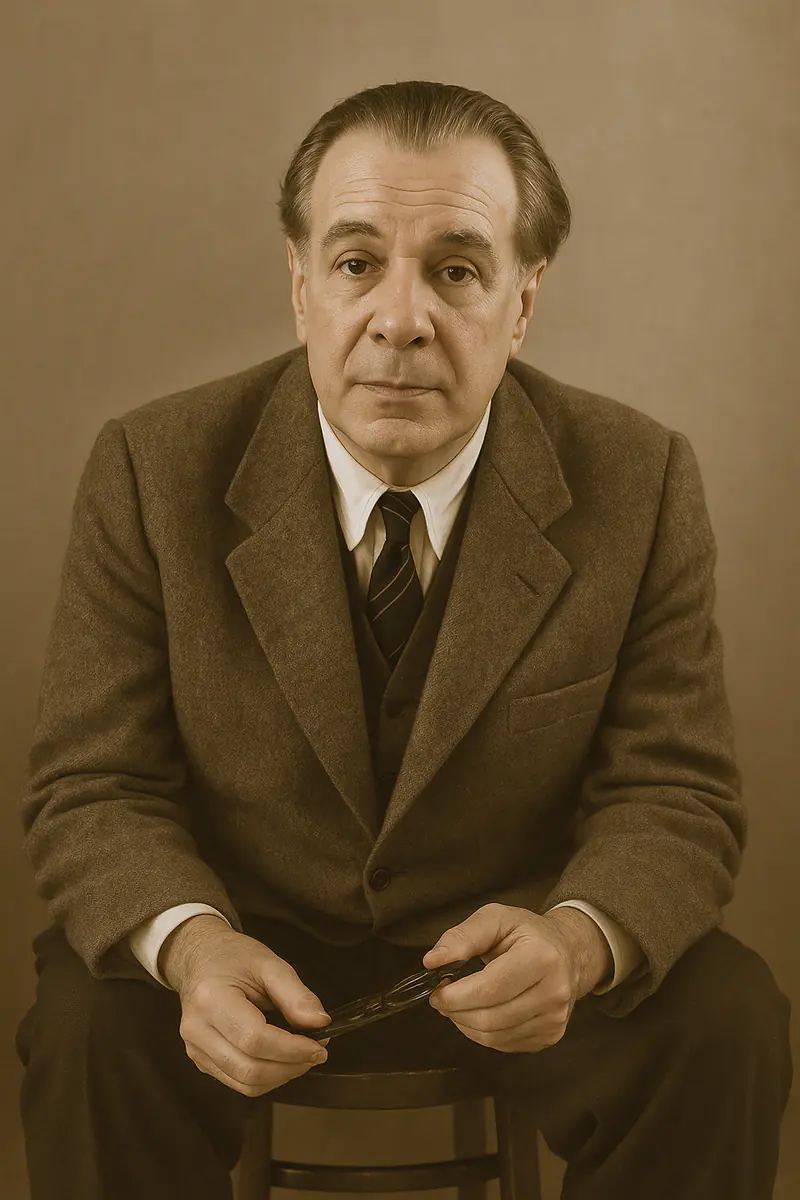
Attr: Grete Stern
| 31 Quotes | |
| Born as | Jorge Francisco Isidoro Luis Borges Acevedo |
| Occup. | Poet |
| From | Argentina |
| Born | August 24, 1899 Buenos Aires, Autonomous City of Buenos Aires, Argentina |
| Died | June 14, 1986 Geneva, Canton of Geneva, Switzerland |
| Cause | Liver cancer |
| Aged | 86 years |
Jorge Francisco Isidoro Luis Borges Acevedo was born on August 24, 1899, in the Palermo neighborhood of Buenos Aires, Argentina. His father, Jorge Guillermo Borges Haslam, was a lawyer and teacher with philosophical interests and partial English ancestry; his mother, Leonor Acevedo Suárez, came from a traditional Argentine family and would be one of his lifelong readers and copyists. Borges and his younger sister, the artist Norah Borges, grew up in a bilingual household. Thanks to an English grandmother and his father's library, he learned to read English before Spanish and devoured Stevenson, Kipling, Poe, and Chesterton alongside Cervantes. As a boy he translated Oscar Wilde's "The Happy Prince" into Spanish, an early sign of his literary vocation.
Education and European Years (1914–1921)
In 1914 the family moved to Europe, initially for his father's eye treatment; the First World War kept them abroad. Borges attended the Collège de Genève, acquiring fluent French and learning German. He discovered Schopenhauer and read philosophy with a zeal that would mark his mature work. After the war he lived in Spain (1919, 1921), mainly in Madrid, where he joined the avant‑garde Ultraísmo movement led by Rafael Cansinos Assens. He formed friendships with Guillermo de Torre and other young poets, published in Ultraist journals, and refined a poetics of sharp metaphors and verbal economy.
Return to Buenos Aires and the Avant‑Garde (1921–1935)
Borges returned to Buenos Aires in 1921 determined to help reinvent Argentine letters. With friends and his sister as designer, he co‑founded the short‑lived "mural" magazine Prisma (1921) and the journal Proa (1922). He forged close ties with writers such as Macedonio Fernández (a philosophical mentor), Ricardo Güiraldes, and the influential editor Victoria Ocampo, whose journal Sur would become central to his career. His first books of poems, Fervor de Buenos Aires (1923), Luna de enfrente (1925), and Cuaderno San Martín (1929), anchored a new, urban lyricism that mingled the local (Buenos Aires patios, street corners, compadritos) with metaphysical curiosity. Essays of this period, including El tamaño de mi esperanza and El idioma de los argentinos, explored language, national identity, and literature's traditions.
From Essayist to Master of Short Fiction (1935–1949)
The mid‑1930s marked a shift toward the hybrid tale-essay that became Borges's hallmark. Historia universal de la infamia (1935) reimagined apocryphal histories and "infamous" characters. After a serious head injury in 1938 and a difficult convalescence, Borges began writing the metaphysical fictions that made his name: "Pierre Menard, autor del Quijote" (1939), "Tlön, Uqbar, Orbis Tertius" (1940), and "El jardín de senderos que se bifurcan" (1941). These and related stories were gathered in Ficciones (1944; expanded 1956), a landmark of world literature, and in El Aleph (1949). He became a key contributor to Ocampo's Sur circle alongside Adolfo Bioy Casares and Silvina Ocampo, with whom he shared ideas, projects, and translations.
Work, Politics, and the Library (1937–1955)
From 1937 Borges held a modest post as a cataloger at the Miguel Cané Municipal Library. During Juan Domingo Perón's first presidency, Borges, an outspoken anti‑fascist and anti‑Peronist, was effectively pushed out of that job; in 1946 he was "promoted" to inspector of poultry and rabbits in municipal markets, a move he declined by resigning. He supported intellectual resistance to authoritarianism, while friends and family, including his mother Leonor and sister Norah, endured harassment and brief imprisonment. Despite political headwinds, he continued to publish essays and stories in Sur and elsewhere and to translate Kafka, Faulkner, and other moderns into Spanish.
Blindness, National Library, and Teaching (1955–1970)
After Perón's fall in 1955, Borges was appointed director of the National Library of Argentina (Biblioteca Nacional) and professor of English and American literature at the University of Buenos Aires. By then he was nearly blind from a hereditary condition, an irony he transformed into art in the poem "Poema de los dones" ("Poem of the Gifts"). He relied on a network of readers, students, friends, and fellow writers, to read and take dictation, among them Adolfo Bioy Casares and, later, Alberto Manguel. He and Bioy Casares published witty parodies and detective stories under the joint pseudonyms H. Bustos Domecq and B. Suárez Lynch, including Seis problemas para don Isidro Parodi (1942). Borges's late-1950s and 1960s volumes, El hacedor (1960), Otras inquisiciones (1952, essays), and successive poetry collections, consolidated his reputation as a poet-essayist-storyteller whose forms continually cross-pollinated.
International Recognition and Translations (1961–1980s)
World recognition arrived decisively in 1961 when Borges shared the inaugural Formentor Prize with Samuel Beckett. English-language collections such as Labyrinths (1962), edited and translated in part by James E. Irby and others, and later collaborations with the translator Norman Thomas di Giovanni in the late 1960s and early 1970s, brought his work to a vast readership. He lectured widely across Europe and the Americas, delivering the Charles Eliot Norton Lectures at Harvard (1967, 1968), later published as This Craft of Verse. Honors accumulated, including Spain's highest literary award, the Cervantes Prize (1979). He never received the Nobel Prize, a much-discussed omission often linked to literary politics and to controversies surrounding his public positions in the 1970s.
Controversies and Public Stances
Borges held a principled disdain for dictatorships of any stripe, yet some of his public gestures proved contentious. In 1976 he accepted honors in Chile and met General Augusto Pinochet, whose regime he naively praised for restoring order; the episode damaged his reputation among many readers. In Argentina he criticized both Peronist demagogy and the military junta's repression, though his condemnations grew sharper as accounts of disappearances mounted. In later interviews he regretted political naïveté and insisted on the writer's duty to defend individual liberty.
Personal Life
Borges's emotional life was marked by profound attachments and missed chances. In the 1940s he shared a complicated romance with the writer Estela Canto, to whom he dedicated "El Aleph". In 1967 he married Elsa Astete Millán, a childhood acquaintance; the marriage ended in divorce in 1970. His mother, Leonor, was his companion and amanuensis until her death in 1975 at nearly 100. In his later years he was close to María Kodama, a student of literature who became his collaborator and traveling companion; they married in 1986. His sister, Norah Borges, an accomplished painter and engraver, illustrated several of his books and remained a central figure in his life.
Themes, Style, and Influences
Borges's fiction and essays braid metaphysics with narrative play. Recurring motifs, labyrinths, mirrors, libraries, knives, dreams, time, doubles, and infinite books, enact philosophical puzzles about identity, free will, and reality. He absorbed idealist and skeptical thinkers (Berkeley, Hume), Schopenhauer's metaphysics, the Kabbalah, and medieval and Nordic literatures. Equally, he drew on Argentine traditions, gaucho tales, compadritos, the payada, and perfected an austere, epigrammatic Spanish influenced by English prose. He favored short forms: the parable-like story, the brief essay, the poem of memory and time. His voice, at once learned and ironic, made citation, translation, and commentary into creative acts.
Selected Works
- Poetry: Fervor de Buenos Aires (1923); Luna de enfrente (1925); El hacedor (1960, mixed forms); Elogio de la sombra (1969); El oro de los tigres (1972); La rosa profunda (1975); La moneda de hierro (1976); Los conjurados (1985)
- Fiction and hybrid works: Historia universal de la infamia (1935); Ficciones (1944; expanded 1956), including "The Garden of Forking Paths", "Pierre Menard, Author of the Quixote", and "The Library of Babel"; El Aleph (1949); El informe de Brodie (1970); El libro de arena (1975); La memoria de Shakespeare (1983)
- Essays and lectures: Discusión (1932); Historia de la eternidad (1936); Otras inquisiciones (1952); Siete noches (1980); Borges oral (1979); Nueve ensayos dantescos (1982); This Craft of Verse (Norton Lectures, published posthumously)
People Around Borges
- Leonor Acevedo Suárez (mother): copyist, companion, and fierce protector of his work
- Norah Borges (sister): painter and illustrator of his books
- Adolfo Bioy Casares (friend and collaborator): coauthor of detective parodies under H. Bustos Domecq; constant interlocutor
- Silvina Ocampo (writer, artist): friend and collaborator within the Sur circle
- Victoria Ocampo (editor): founder of Sur; champion of Borges's work
- Macedonio Fernández (mentor): philosophical influence during Borges's formative years in Buenos Aires
- Rafael Cansinos Assens (mentor in Spain): leader of Ultraísmo; early patron
- Ricardo Güiraldes (novelist): friend and supporter in the 1920s
- Estela Canto (writer): dedicatee of "El Aleph" and significant romantic relationship
- Elsa Astete Millán (first wife): married 1967, divorced 1970
- María Kodama (second wife): collaborator and literary executor; married 1986
- Norman Thomas di Giovanni (translator): key partner in English translations in the late 1960s, 1970s
- James E. Irby, Anthony Kerrigan, and others (translators): helped establish Borges in English
- Alberto Manguel (writer): read aloud to Borges in the 1960s; later wrote about the experience
Death and Legacy
Borges died in Geneva, Switzerland, on June 14, 1986, of liver cancer. He was buried in the Cimetière des Rois (Plainpalais Cemetery); his tomb bears inscriptions in Old Norse and Old English that salute the heroic past he loved. His influence is immeasurable: he reshaped the possibilities of the short story, pioneered an erudite yet playful modernism, and inspired writers across languages, among them Italo Calvino, Umberto Eco, John Barth, Paul Auster, Roberto Bolaño, and Julio Cortázar. For generations of readers, Borges made literature a laboratory for ideas and a mirror-maze where the boundaries between essay, fiction, and poem dissolve.
Our collection contains 31 quotes who is written by Jorge, under the main topics: Witty One-Liners - Ethics & Morality - Wisdom - Truth - Love.
Other people realated to Jorge: Antonio Porchia (Poet), Octavio Paz (Poet), Gene Wolfe (Writer), James Laughlin (Poet), Jonathan Carroll (Author)
Frequently Asked Questions
- Jorge Luis Borges Labyrinths: A 1962 English-language collection of stories and essays, published by New Directions.
- Jorge Luis Borges awards: Formentor Prize (1961); Jerusalem Prize (1971); Cervantes Prize (1979).
- Short stories by Jorge Luis Borges: The Library of Babel; The Garden of Forking Paths; The Aleph; Death and the Compass; The South.
- Jorge Luis Borges born: August 24, 1899, Buenos Aires, Argentina.
- Jorge Luis Borges famous works: Ficciones; The Aleph; The Library of Babel; The Garden of Forking Paths; Tlön, Uqbar, Orbis Tertius.
- Jorge Luis Borges death: June 14, 1986, in Geneva, Switzerland.
- Jorge Luis Borges - poemas: Fervor de Buenos Aires; Luna de enfrente; El otro, el mismo; El hacedor; El oro de los tigres.
- Jorge Luis Borges books: Ficciones; El Aleph; The Book of Sand (El libro de arena); Historia universal de la infamia; Labyrinths (English anthology).
- How old was Jorge Luis Borges? He became 86 years old
Jorge Luis Borges Famous Works
- 1980 Siete noches (Essay)
- 1975 El libro de arena (Collection)
- 1972 El oro de los tigres (Poetry)
- 1970 El informe de Brodie (Collection)
- 1967 El libro de los seres imaginarios (Non-fiction)
- 1964 El otro, el mismo (Poetry)
- 1960 El hacedor (Collection)
- 1952 Otras inquisiciones (Essay)
- 1949 El Aleph (Collection)
- 1944 Ficciones (Collection)
- 1935 Historia universal de la infamia (Collection)
- 1932 Discusión (Essay)
- 1930 Evaristo Carriego (Biography)
- 1929 Cuaderno San Martín (Poetry)
- 1925 Inquisiciones (Essay)
- 1925 Luna de enfrente (Poetry)
- 1923 Fervor de Buenos Aires (Poetry)
Source / external links