
Miguel de Cervantes Biography Quotes 51 Report mistakes
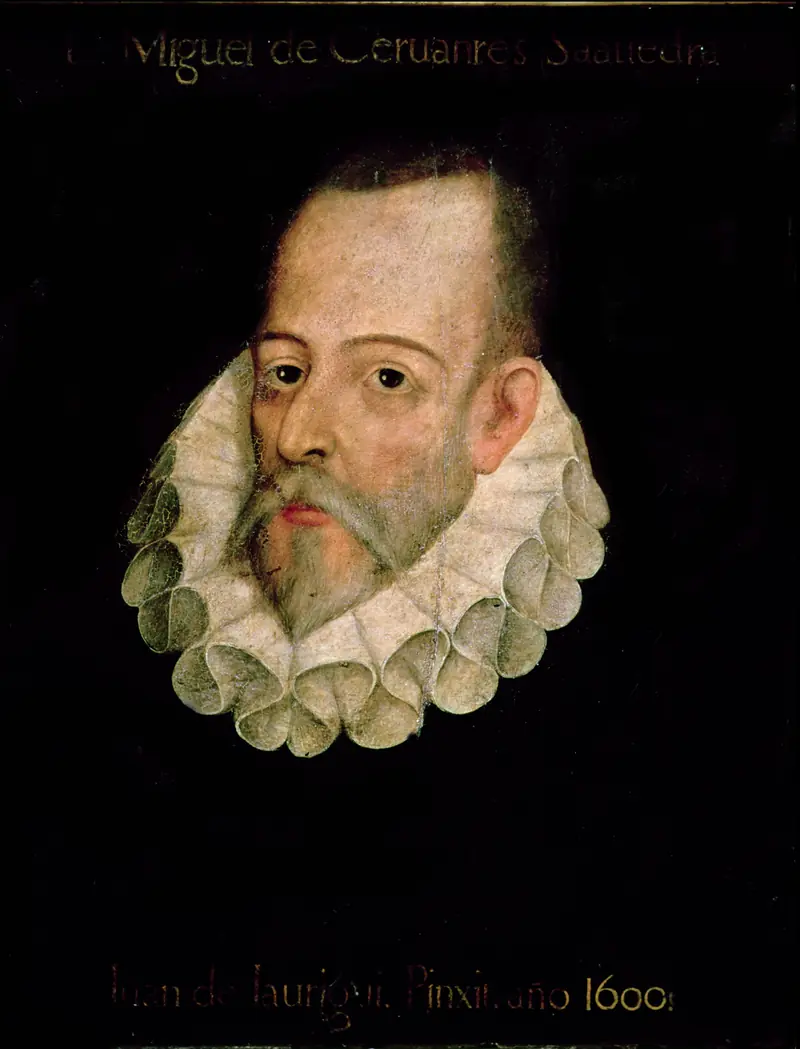
Attr: Juan Martínez de Jáuregui y Aguilar
| 51 Quotes | |
| Occup. | Novelist |
| From | Spain |
| Born | September 29, 1547 |
| Died | April 23, 1616 |
| Aged | 68 years |
Miguel de Cervantes Saavedra was born in Alcala de Henares in 1547 and baptized on 29 September of that year. His parents, Rodrigo de Cervantes, a barber-surgeon, and Leonor de Cortinas, moved frequently as the family pursued work and solvency across Castile. The household included several siblings, among them Andrea, Magdalena, and Rodrigo, and the instability of their fortunes exposed Cervantes early to the varied tones of Spanish society. In Madrid he came under the guidance of the humanist Juan Lopez de Hoyos, who praised him as a dear pupil and printed several of his youthful poems in a memorial volume for Queen Isabel de Valois in 1568. This brief public acclaim signaled a literary bent, but circumstances soon drew him abroad.
Soldier and Captive
By 1569 Cervantes was in Italy, where he likely served in the household of Cardinal Giulio Acquaviva before enlisting in the Spanish forces housed in Naples. In 1571 he sailed with the fleet commanded by Don John of Austria and fought at the Battle of Lepanto aboard the galley Marquesa. He received multiple wounds, including a shot that damaged his left hand, earning the sobriquet el manco de Lepanto. Despite this disability, he continued his service in the Mediterranean.
In 1575, returning to Spain with his brother Rodrigo, he was seized by Barbary corsairs led by Arnaut Mami and taken to Algiers. Cervantes endured five harsh years in captivity under the regency of Hasan Pasha, organizing several daring but unsuccessful escape attempts that, according to witnesses, aimed to free not only himself but fellow captives. Rodrigo was ransomed earlier; Miguel remained until 1580, when Trinitarian friars, among them Juan Gil and Anton de la Bella, secured his release. The memory of Algiers would later surface in his plays and in episodes of his prose, where he explored honor, endurance, and the ambiguous fortunes of freedom.
Return to Spain and Search for Livelihood
Cervantes returned to a Spain entering its imperial maturity yet fraught with financial strains. In 1584 he married Catalina de Salazar y Palacios in Esquivias, gaining ties to a family of small landholders. He also had a daughter, Isabel de Saavedra, whose life remained closely connected with his later years. Despite aspirations to letters, he relied on administrative posts: as a commissary tasked with gathering grain and oil for the Armada in Andalusia, and later as a tax collector associated with the royal treasury. These employments brought him across the breadth of southern Spain and into frequent conflict with local authorities. Twice he was jailed for accounting irregularities, and tradition holds that the experience of confinement helped crystallize his literary ambitions. He himself later wrote that some pages of his great book began in a prison.
Apprenticeship as a Writer
His first published book, the pastoral novel La Galatea (1585), followed conventions of the day while already hinting at his gift for ironical observation. In the theater he pursued comedias and interludes, but the explosive success of Lope de Vega on the Madrid stages overshadowed his efforts. Cervantes complained of playhouse tastes and the economics of playwriting, yet he maintained friendships and rivalries within that bustling world that also included figures like Luis de Gongora and, later, Francisco de Quevedo. The competitive literary market shaped his experiments with voice, genre, and audience.
Don Quixote and Its Making
The first part of Don Quixote appeared in Madrid in 1605, printed by Juan de la Cuesta for the bookseller Francisco de Robles and dedicated to the Duke of Bejar. The novel wove the delusions of a would-be knight, Alonso Quijano, and the earthy prudence of his squire, Sancho Panza, into a new kind of narrative that mixed parody with deep sympathy. Its immediate success produced swift reprints and translations, including Thomas Shelton's early English version. Cervantes, now living among printers, actors, and patrons, rode a surge of notoriety but gained limited wealth, as rights and profits largely accrued to others in the book trade.
In 1614 an anonymous writer signing as Alonso Fernandez de Avellaneda issued a spurious sequel. The provocation galvanized Cervantes. He responded within the fiction of his own Second Part (1615), where characters discuss the counterfeit book and choose their paths accordingly. This audacious device reinforced the novel's self-awareness and its meditation on authorship, fame, and truth. The Second Part was dedicated to Pedro Fernandez de Castro, the Count of Lemos, whose patronage offered Cervantes late-life encouragement.
Other Works and Literary World
Between the two parts of Don Quixote, Cervantes published the Novelas ejemplares (1613), a suite of short fictions that ranged from picaresque comedy to moral fable. He followed with Viaje del Parnaso (1614), a satirical poem on poets and poetry, and Ocho comedias y ocho entremeses (1615), which preserved in print his deft one-act interludes even as the mainstage comedia remained dominated by Lope de Vega. These books display the breadth of his craft: experiments with perspective, colloquial vitality, and a steady, humane irony.
Cervantes moved through the same Madrid streets as Lope de Vega and exchanged barbs typical of the era's polemical culture. Printers like Juan de la Cuesta and booksellers such as Francisco de Robles mediated his access to readers, while noble patrons, especially the Count of Lemos, offered symbolic capital and occasional stipends. Within his household, his wife Catalina, his daughter Isabel, and his sisters formed a close circle that supported his late productivity.
Final Years and Death
In his final years Cervantes embraced a more devout piety and was associated with the Secular Franciscan order. He completed Los trabajos de Persiles y Sigismunda, a romance of adventurous travel and spiritual testing that he considered his most polished work. He signed its dedication shortly before his death in Madrid on 22 April 1616, and the book appeared posthumously in 1617. Cervantes was buried in the Convent of the Barefoot Trinitarians, a fitting place given the order's role in his liberation from Algiers decades earlier.
Legacy
Cervantes left a body of work that transformed European narrative. Don Quixote forged a world where books shape life and life reshapes books, where the talk of a witty squire can carry the weight of philosophy, and where illusion and reality interrogate each other without exhaustion. The novel's reach was immediate and global, influencing writers as diverse as Henry Fielding, Gustave Flaubert, and Fyodor Dostoevsky, while the word quixotic entered many languages as a sign of lofty, impractical idealism.
His career tracked the contours of Spain's Golden Age: imperial battles, captivity, patronage, theatrical innovation, and the commerce of print. Along the way stand the figures who marked his path: Don John of Austria at Lepanto, the Trinitarians in Algiers, Juan Lopez de Hoyos in Madrid, Lope de Vega in the theater, printers like Juan de la Cuesta, and patrons such as the Count of Lemos. Through hardship and ingenuity, Cervantes forged a new prose capable of containing the contradictions of his world, and in doing so he offered later ages the image of an author who, after long apprenticeship and many reversals, wrote a book that teaches readers to see.
Our collection contains 51 quotes who is written by Miguel, under the main topics: Witty One-Liners - Motivational - Ethics & Morality - Wisdom - Truth.
Other people realated to Miguel: Alejo Carpentier (Novelist)
Miguel de Cervantes Famous Works
- 1617 The Trials of Persiles and Sigismunda (Novel)
- 1613 The Exemplary Novels (Novellas)
- 1611 The Comical History of the Simpleton Fool (Play)
- 1605 Don Quixote (Novel)
- 1585 The Siege of Numantia (Play)
Source / external links