
Wallace Stevens Biography Quotes 39 Report mistakes
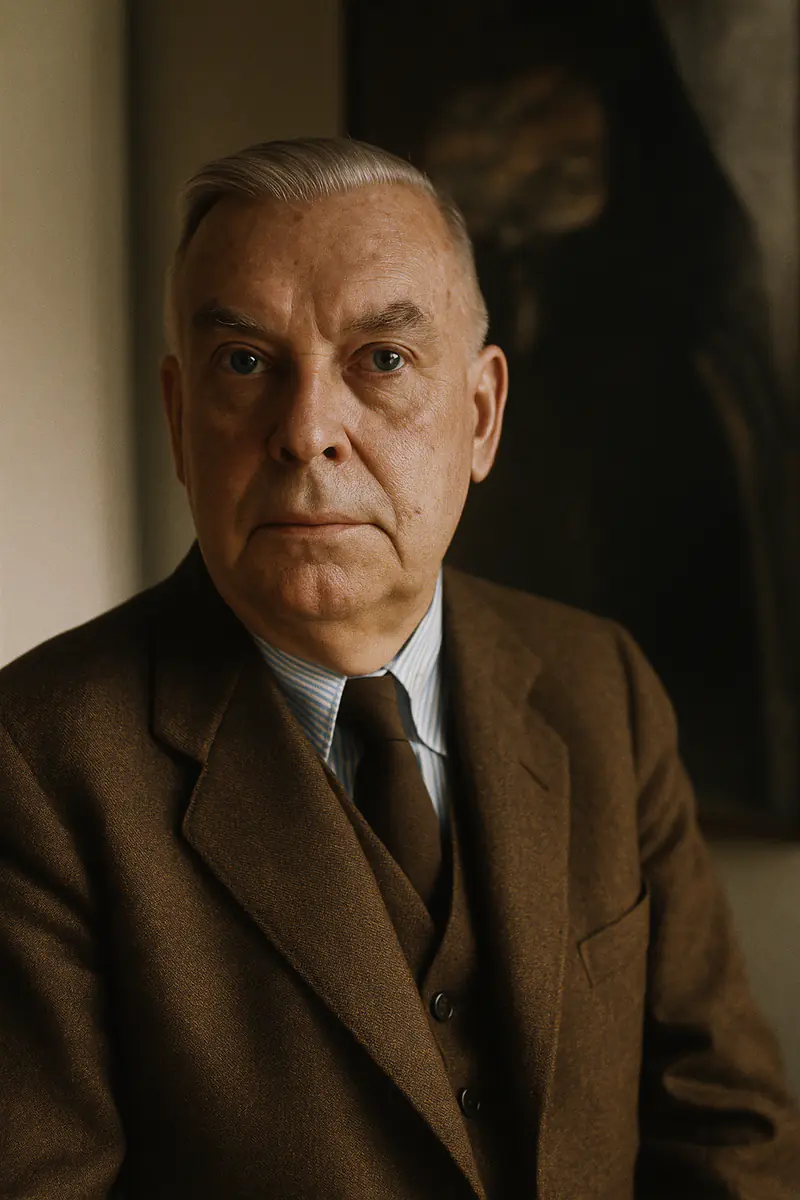
| 39 Quotes | |
| Occup. | Poet |
| From | USA |
| Born | October 2, 1879 Reading, Pennsylvania, United States |
| Died | August 2, 1955 Hartford, Connecticut, United States |
| Aged | 75 years |
Wallace Stevens was born on October 2, 1879, in Reading, Pennsylvania, into a prosperous, disciplined household shaped by the ambitions of a small American city in the Gilded Age. His father, Garrett Barna Stevens, was a lawyer and a steady civic presence; his mother, Margaret Catherine Zeller, brought a quieter cultural ballast. From the start Stevens lived between worlds - the practical, money-counting America of railroads and insurance tables, and an inward America of sensation, weather, and the mind making meaning from it.
That doubleness hardened into temperament. Stevens developed the habit of privacy early, preferring controlled rooms to confessional display, and he carried a lifelong reserve that friends sometimes read as hauteur and biographers recognize as self-protection. He would spend his adult life in offices and on measured walks, cultivating a domestic life with his wife, Elsie Kachel Stevens, and their daughter, Holly, while writing poems that insist the imagination is not escape but a way of bearing the world as it is lived.
Education and Formative Influences
Stevens attended Harvard University (1897-1900), writing for the Harvard Advocate and absorbing philosophy, the classics, and the era's arguments about realism and idealism; he briefly moved in the orbit of William James without becoming a disciple. Family pressure and his own sense of vocation led him away from an academic path: after leaving Harvard he worked as a journalist in New York and then entered New York Law School, earning his law degree in 1903, a choice that set the terms of his life-long negotiation between earning and imagining.
Career, Major Works, and Turning Points
Stevens practiced law, joined the insurance world, and in 1916 moved to Hartford, Connecticut, where he became a senior executive at the Hartford Accident and Indemnity Company, eventually vice president - a stable, almost ascetic professional life running alongside a slowly unfolding literary one. He published late by modern standards: Harmonium (1923) announced a new American music of thought, color, and irony; then came a long interval as he revised and deepened his project in Ideas of Order (1935), The Man with the Blue Guitar (1937), Parts of a World (1942), Transport to Summer (1947), The Auroras of Autumn (1950), and The Rock (1954). The turning point was not a public scandal but an internal consolidation: the mature Stevens accepted that the office and the poem were not enemies, and he built a body of work that made modern consciousness - skeptical, sensuous, hungry for order - into form.
Philosophy, Style, and Themes
Stevens wrote in an era that watched old certainties collapse under modernity - world war, technological acceleration, shifting faith - and he responded not with prophecy but with a rigorous poetics of perception. He distrusted inherited metaphysics yet refused nihilism; his poems dramatize how the mind composes "reality" through language, attention, and desire. "Reality is not what it is. It consists of the many realities which it can be made into". That line captures his psychology: a man wary of being mastered by circumstance, determined to master experience through precision, and honest that this mastery is creative, not merely reportorial.
His style is famously lush and exacting: bright objects, tropical colors, crisp New England weather, and abstract nouns that behave like characters in a debate. The poems test how beauty survives finitude, turning death into a spur rather than a silence: "Death is the mother of Beauty; hence from her, alone, shall come fulfillment to our dreams and our desires". Yet Stevens is not only elegiac; he is a poet of resilience after skepticism, arguing for a hard-won affirmation that follows refusal: "After the final no there comes a yes and on that yes the future of the world hangs". The "yes" in Stevens is not naive belief but a disciplined consent to the world, achieved through the imagination's power to reorder what threatens to overwhelm.
Legacy and Influence
Stevens died on August 2, 1955, in Hartford, leaving a model of the modern poet as a working citizen whose deepest rebellions occur in syntax and thought. His influence runs through postwar American poetry - from John Ashbery's intellectual play to the meditative rigor of later lyric philosophers - and into criticism, where his essays and poems became touchstones for debates about imagination, reality, and the secular sacred. Stevens endures because he made a credible inner life for the twentieth century: private but not evasive, skeptical but not barren, a poetry that teaches readers to see the world again by remaking it in words.
Our collection contains 39 quotes who is written by Wallace, under the main topics: Witty One-Liners - Wisdom - Truth - Art - Learning.
Other people realated to Wallace: Harold Bloom (Critic), Marianne Moore (Poet), James Laughlin (Poet)
Frequently Asked Questions
- Wallace Stevens wife: Elsie Viola Kachel Stevens
- Wallace Stevens pronunciation: WALL-iss STEE-vinz
- Wallace Stevens famous works: The Collected Poems (Pulitzer Prize); Harmonium; The Idea of Order at Key West; Thirteen Ways of Looking at a Blackbird; Sunday Morning
- Wallace Stevens poems: The Emperor of Ice-Cream; Thirteen Ways of Looking at a Blackbird; Sunday Morning; The Idea of Order at Key West; Anecdote of the Jar; The Snow Man
- Wallace Stevens books: Harmonium; Ideas of Order; The Man with the Blue Guitar; Parts of a World; Transport to Summer; The Auroras of Autumn; The Collected Poems
- Wallace Stevens died: August 2, 1955, Hartford, Connecticut
- How old was Wallace Stevens? He became 75 years old
Wallace Stevens Famous Works
- 1957 Opus Posthumous (Collection)
- 1954 The Collected Poems of Wallace Stevens (Collection)
- 1951 The Necessary Angel: Essays on Reality and the Imagination (Essay)
- 1950 The Auroras of Autumn (Poetry)
- 1947 Transport to Summer (Poetry)
- 1942 Parts of a World (Poetry)
- 1942 Notes Toward a Supreme Fiction (Poetry)
- 1937 The Man with the Blue Guitar (Poetry)
- 1935 Ideas of Order (Poetry)
- 1923 Harmonium (Poetry)
- 1922 The Emperor of Ice-Cream (Poetry)
- 1919 Anecdote of the Jar (Poetry)
- 1917 Thirteen Ways of Looking at a Blackbird (Poetry)
Source / external links