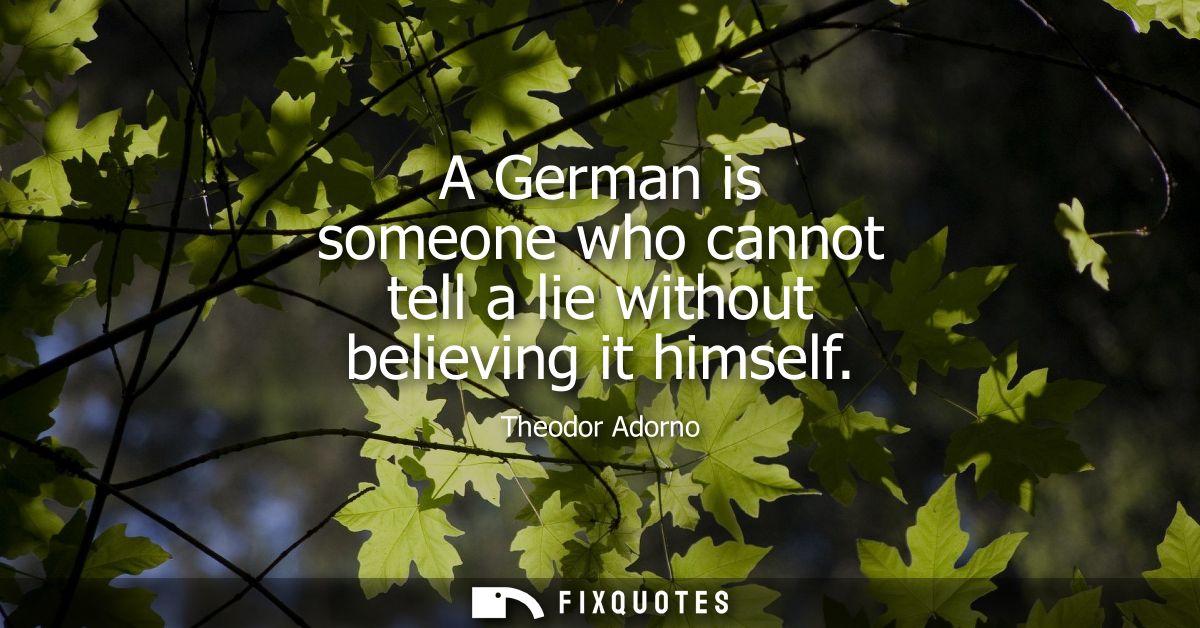
"A German is someone who cannot tell a lie without believing it himself"
About this Quote
The intent is polemical and self-implicating. Adorno, a German-Jewish intellectual in exile during the Nazi era, had watched a modern, literate society rationalize barbarism through bureaucratic language, myths of destiny, and the cultivated seriousness of “duty.” His broader project in the Dialectic of Enlightenment and later essays is to show how reason, stripped of self-critique, curdles into instrumental thinking: efficient, organized, and easily recruited by authoritarianism. In that light, “cannot tell a lie without believing it” is a critique of a culture trained to confuse obedience with truth.
The subtext cuts two ways: it mocks the German ideal of earnestness (no irony, no performance) while indicting the mechanisms that make propaganda feel internally consistent. Adorno’s sting is that the problem isn’t merely cynics at the top lying to the masses; it’s a whole atmosphere where people tell themselves stories so thoroughly they can no longer hear the dissonance. That’s how historical catastrophe gets a clean conscience.
Quote Details
| Topic | Sarcastic |
|---|---|
| Source | Help us find the source |
| Cite |
Citation Formats
APA Style (7th ed.)
Adorno, Theodor. (2026, January 15). A German is someone who cannot tell a lie without believing it himself. FixQuotes. https://fixquotes.com/quotes/a-german-is-someone-who-cannot-tell-a-lie-without-444/
Chicago Style
Adorno, Theodor. "A German is someone who cannot tell a lie without believing it himself." FixQuotes. January 15, 2026. https://fixquotes.com/quotes/a-german-is-someone-who-cannot-tell-a-lie-without-444/.
MLA Style (9th ed.)
"A German is someone who cannot tell a lie without believing it himself." FixQuotes, 15 Jan. 2026, https://fixquotes.com/quotes/a-german-is-someone-who-cannot-tell-a-lie-without-444/. Accessed 12 Feb. 2026.