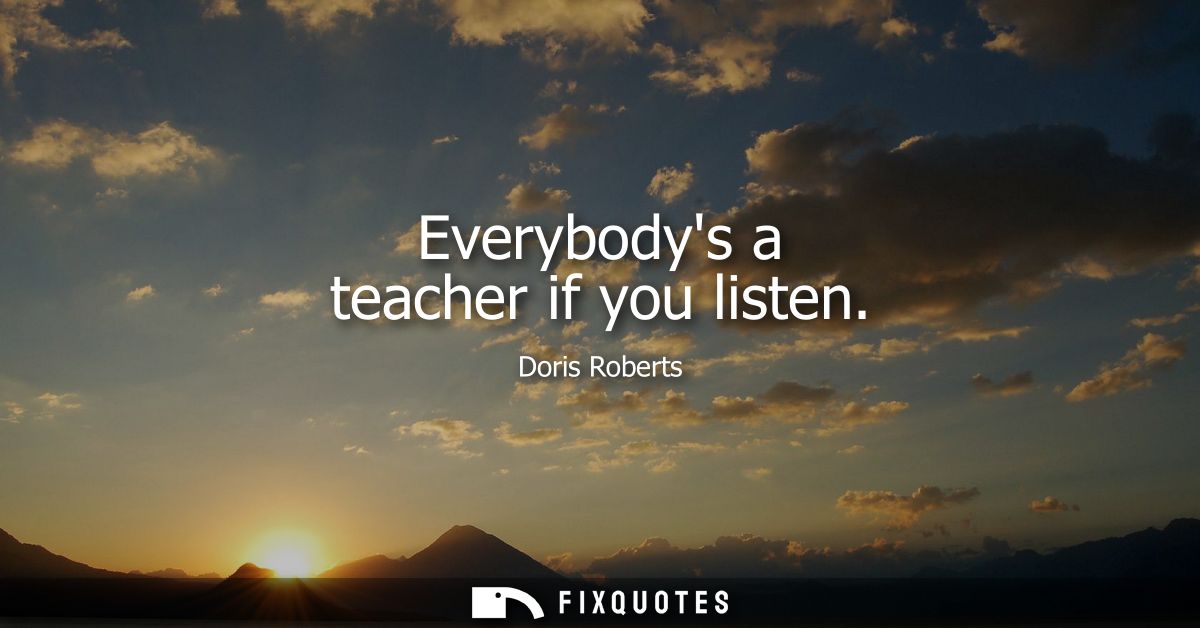
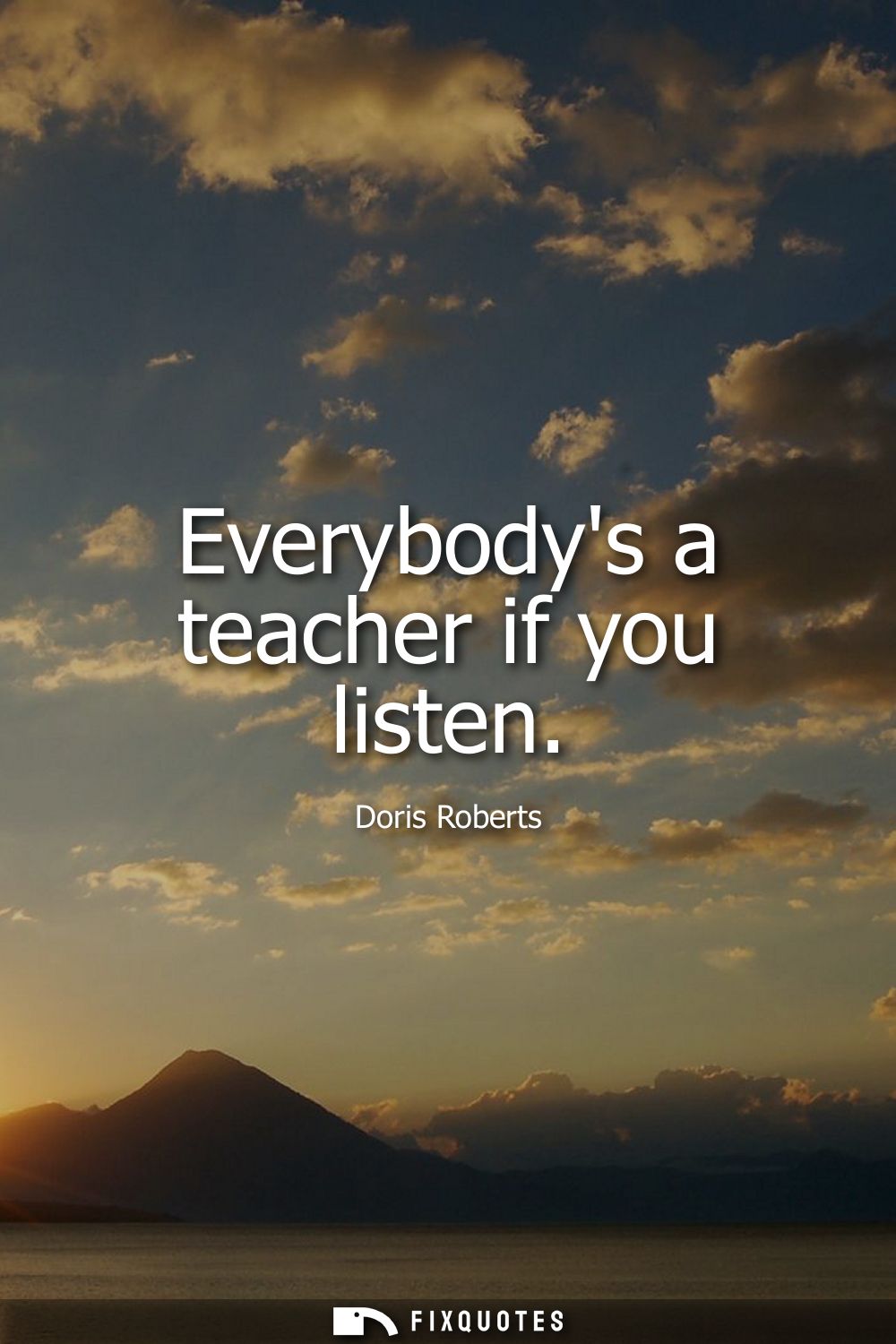
"Everybody's a teacher if you listen"
About this Quote
The line reframes education as a democratic, everyday practice: the world becomes a classroom the moment you meet it with attention. People do not have to intend to teach for you to learn from them. A child asking a blunt question, a clerk remaining calm in a rush, a friend confessing a mistake, even a rude driver cutting you off all carry lessons about curiosity, patience, vulnerability, and consequence. Listening turns ordinary encounters into curriculum.
Listening here is not the passive act of hearing. It is the active choice to suspend judgment long enough to notice nuance, to ask what a person is trying to solve, protect, or express. That stance broadens your repertoire of responses to life. You acquire empathy not as a slogan but as a skill, because you have practiced entering other frames of reference. Some lessons are inspirational; others are cautionary. Both are valuable. The phrase also invites humility: if everybody is a teacher, then no one has a monopoly on wisdom, and expertise must stay porous.
Doris Roberts understood this from the inside of her craft. An actor thrives by listening. Timing, chemistry, and believable reaction depend on attention to the other person. Roberts, whose long career spanned stage and screen and whose Marie Barone felt both outsized and recognizable, drew comedy from sharp observation of ordinary family dynamics. She studied people and their rhythms, and the audience felt seen because she had listened first. The line also echoes her advocacy for treating work colleagues and younger performers with respect; the next insight may come from the least expected place.
Amid a culture that rewards broadcasting and hot takes, the maxim feels quietly radical. If you approach the day as a student of other lives, you waste fewer conflicts, repeat fewer errors, and discover more kinship. Wisdom accrues not from collecting answers but from cultivating the habit that lets teachers appear everywhere.
Listening here is not the passive act of hearing. It is the active choice to suspend judgment long enough to notice nuance, to ask what a person is trying to solve, protect, or express. That stance broadens your repertoire of responses to life. You acquire empathy not as a slogan but as a skill, because you have practiced entering other frames of reference. Some lessons are inspirational; others are cautionary. Both are valuable. The phrase also invites humility: if everybody is a teacher, then no one has a monopoly on wisdom, and expertise must stay porous.
Doris Roberts understood this from the inside of her craft. An actor thrives by listening. Timing, chemistry, and believable reaction depend on attention to the other person. Roberts, whose long career spanned stage and screen and whose Marie Barone felt both outsized and recognizable, drew comedy from sharp observation of ordinary family dynamics. She studied people and their rhythms, and the audience felt seen because she had listened first. The line also echoes her advocacy for treating work colleagues and younger performers with respect; the next insight may come from the least expected place.
Amid a culture that rewards broadcasting and hot takes, the maxim feels quietly radical. If you approach the day as a student of other lives, you waste fewer conflicts, repeat fewer errors, and discover more kinship. Wisdom accrues not from collecting answers but from cultivating the habit that lets teachers appear everywhere.
Quote Details
| Topic | Teaching |
|---|
More Quotes by Doris
Add to List