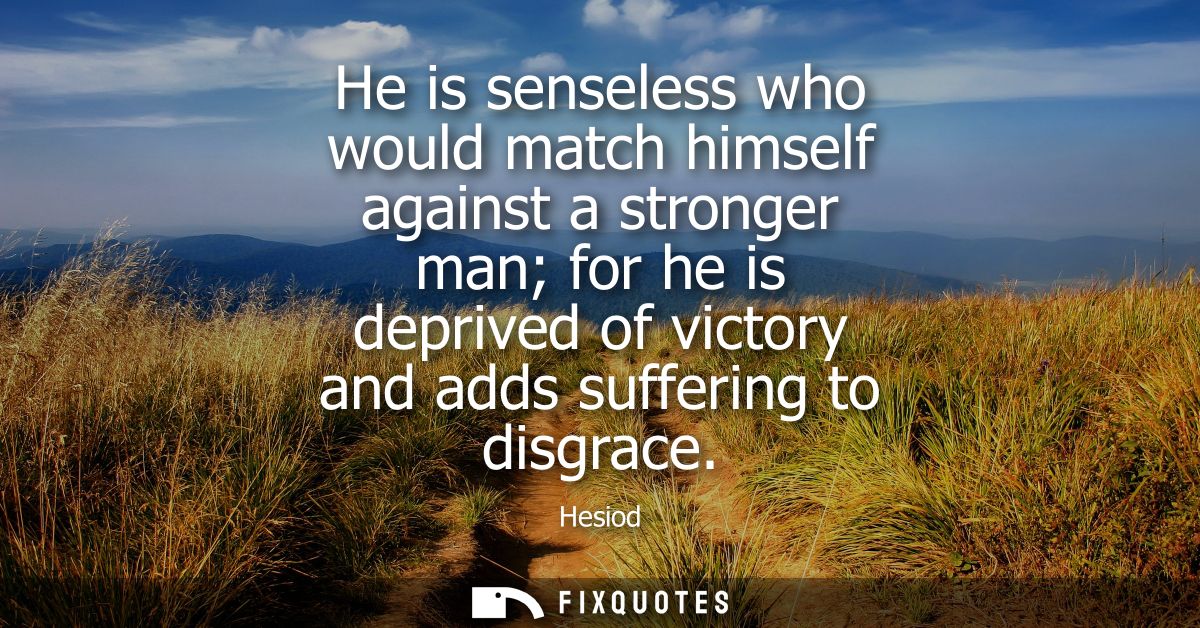
"He is senseless who would match himself against a stronger man; for he is deprived of victory and adds suffering to disgrace"
About this Quote
Hesiod distills a hard lesson of human limits and social reality. To pit oneself against a stronger opponent is not bravery but folly, because the contest is decided before it begins. The loser walks away not only beaten but humiliated, carrying physical pain and the stain of public shame. The aphorism assumes a world where reputation matters and where overreaching brings a double penalty. Prudence, not bravado, is the marker of intelligence.
The line fits the moral economy of Works and Days, Hesiods didactic poem addressed to his brother Perses. Perses had squandered his inheritance and sought advantage through lawsuits and the favor of corrupt rulers. Against that backdrop, the warning targets more than fistfights; it speaks to litigation, rivalries, and contests of status in a community governed by strength as much as by justice. Hesiod cautions a small farmer to avoid provoking more powerful men, because the courts can be partial and power often protects itself. Better to work, husband resources, and seek the protection of Zeus through justice than to charge headlong into a rigged battle.
The maxim also pushes back against hubris. Greek thought prizes sophrosyne, self-control and measure; knowing when not to fight is as important as courage. Hesiod elsewhere distinguishes two kinds of Strife: the destructive force that breeds violence and the useful competitiveness that spurs labor. Challenging the stronger belongs to the former; improving ones own capacity and station belongs to the latter. The counsel is not cowardice but strategy. Choose contests where character, skill, and preparation can prevail; build alliances; appeal to lawful order rather than naked force. The sane response to power is not futile defiance but incremental strengthening, so that when conflict is unavoidable, one is no longer the weaker party. In a society where disgrace lingers, restraint becomes a form of wisdom, saving a person from wounds and from the deeper injury of lost honor.
The line fits the moral economy of Works and Days, Hesiods didactic poem addressed to his brother Perses. Perses had squandered his inheritance and sought advantage through lawsuits and the favor of corrupt rulers. Against that backdrop, the warning targets more than fistfights; it speaks to litigation, rivalries, and contests of status in a community governed by strength as much as by justice. Hesiod cautions a small farmer to avoid provoking more powerful men, because the courts can be partial and power often protects itself. Better to work, husband resources, and seek the protection of Zeus through justice than to charge headlong into a rigged battle.
The maxim also pushes back against hubris. Greek thought prizes sophrosyne, self-control and measure; knowing when not to fight is as important as courage. Hesiod elsewhere distinguishes two kinds of Strife: the destructive force that breeds violence and the useful competitiveness that spurs labor. Challenging the stronger belongs to the former; improving ones own capacity and station belongs to the latter. The counsel is not cowardice but strategy. Choose contests where character, skill, and preparation can prevail; build alliances; appeal to lawful order rather than naked force. The sane response to power is not futile defiance but incremental strengthening, so that when conflict is unavoidable, one is no longer the weaker party. In a society where disgrace lingers, restraint becomes a form of wisdom, saving a person from wounds and from the deeper injury of lost honor.
Quote Details
| Topic | Wisdom |
|---|
More Quotes by Hesiod
Add to List