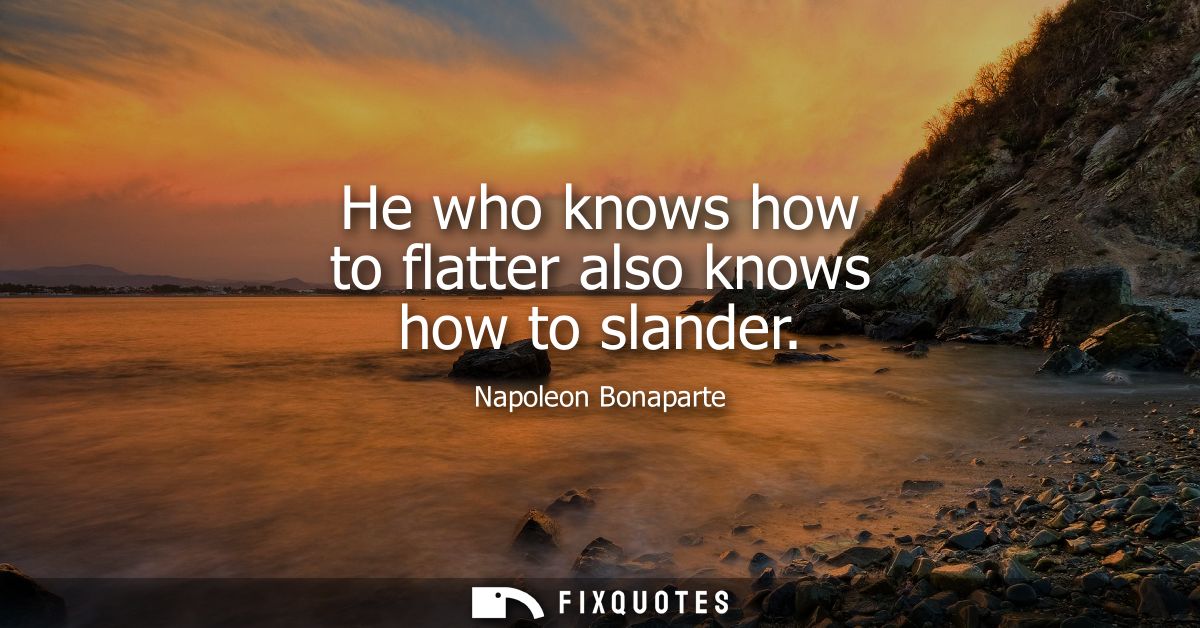
"He who knows how to flatter also knows how to slander"
About this Quote
Flattery and slander look like opposites, but Napoleon cuts through the disguise: they are twins in the same political craft, different costumes for the same impulse to control a room. Coming from a leader who rose on charisma, propaganda, and the ruthless management of reputation, the line reads less like moral advice than a field manual. If you can sweet-talk someone into trust, you can just as easily weaponize that intimacy by turning praise into insinuation, admiration into narrative. The skill set is identical: reading vanity, spotting leverage points, tailoring language to an audience's hunger.
The subtext is a warning about persuasion itself. Flattery is not merely politeness; it is a diagnostic tool that maps a person's insecurities and desires. Once you know what someone wants to hear, you also know what will bruise them, what will make others doubt them, what rumor will stick. Napoleon is describing an information economy where credibility is manufactured, not earned. The flatterer isn't harmless; he is collecting data.
Context matters. Napoleon governed in an era of tight social hierarchies and volatile loyalties, where survival depended on patronage networks, courtly performance, and the press as a battlefield. Under those conditions, language becomes cavalry: swift, strategic, and capable of trampling reputations. The quote’s rhetorical power lies in its cynicism masquerading as clarity. It punctures the comforting idea that praise is inherently benevolent, insisting that the most seductive voices are often the most dangerous because they know exactly how to reverse the current.
The subtext is a warning about persuasion itself. Flattery is not merely politeness; it is a diagnostic tool that maps a person's insecurities and desires. Once you know what someone wants to hear, you also know what will bruise them, what will make others doubt them, what rumor will stick. Napoleon is describing an information economy where credibility is manufactured, not earned. The flatterer isn't harmless; he is collecting data.
Context matters. Napoleon governed in an era of tight social hierarchies and volatile loyalties, where survival depended on patronage networks, courtly performance, and the press as a battlefield. Under those conditions, language becomes cavalry: swift, strategic, and capable of trampling reputations. The quote’s rhetorical power lies in its cynicism masquerading as clarity. It punctures the comforting idea that praise is inherently benevolent, insisting that the most seductive voices are often the most dangerous because they know exactly how to reverse the current.
Quote Details
| Topic | Honesty & Integrity |
|---|
More Quotes by Napoleon
Add to List