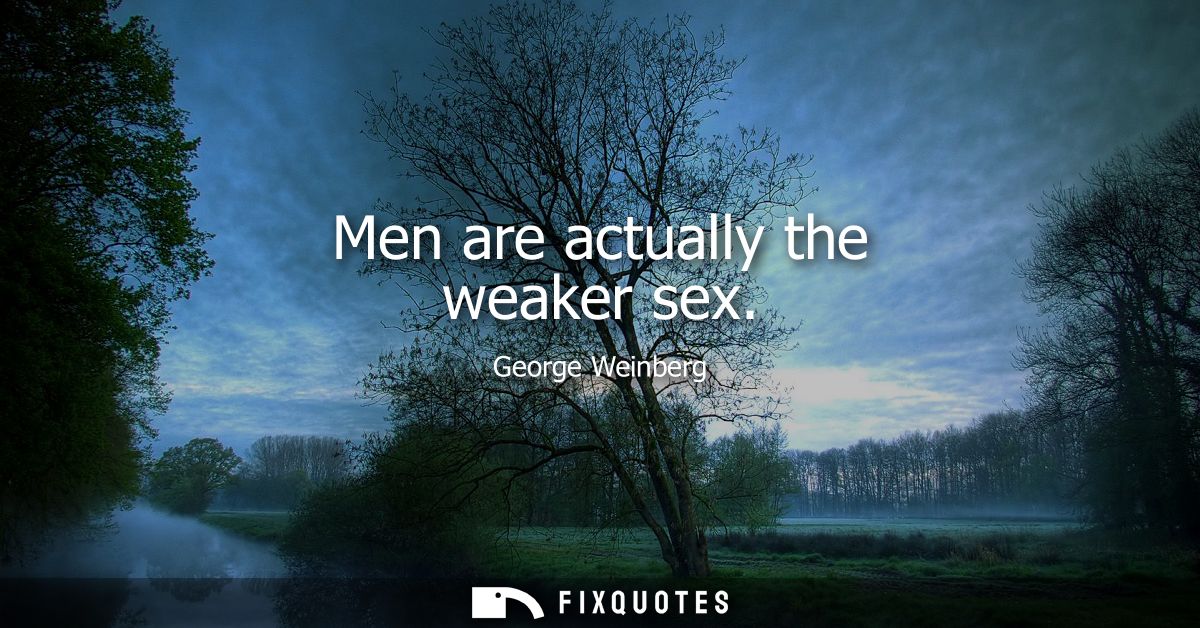
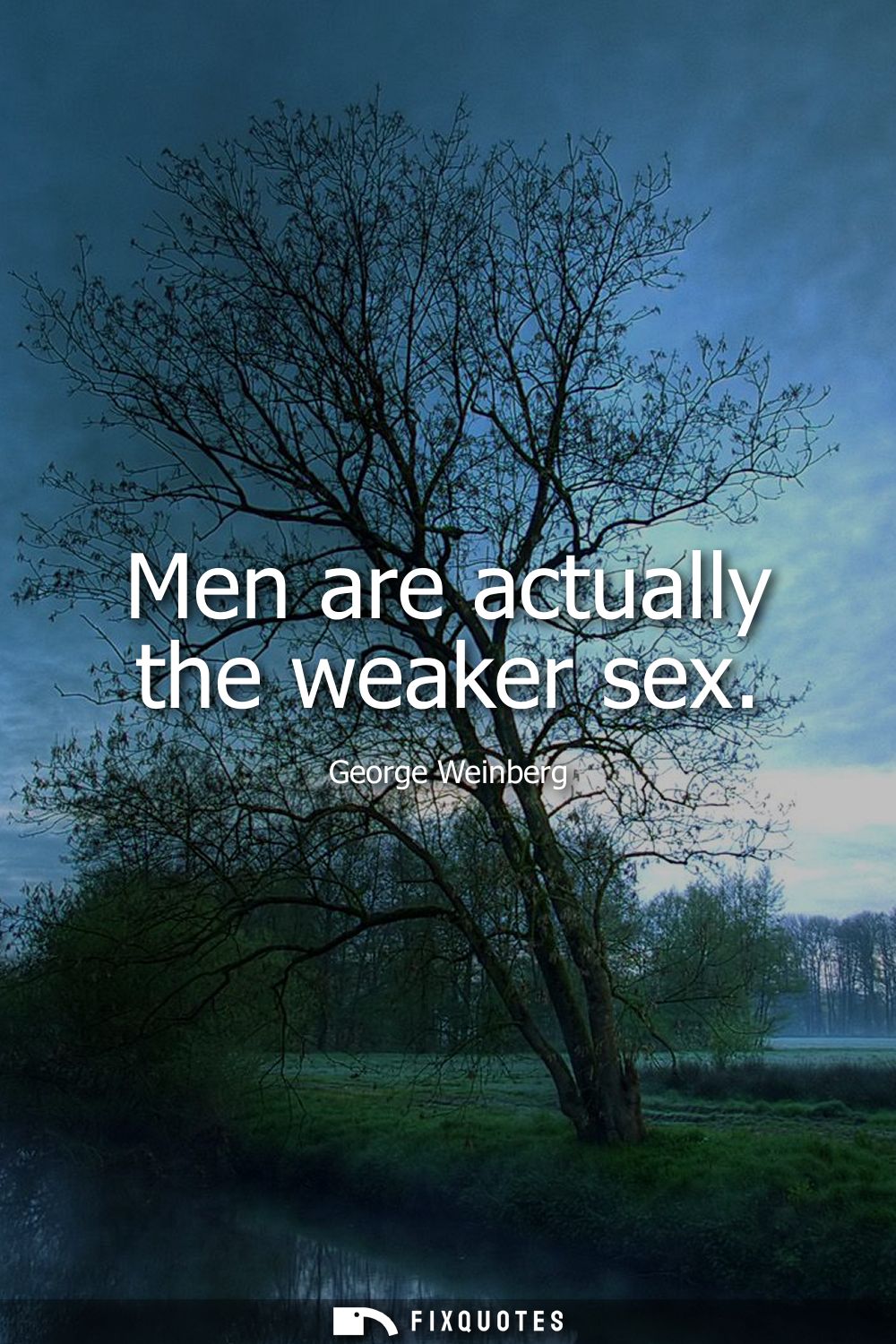
"Men are actually the weaker sex"
About this Quote
"Men are actually the weaker sex" lands like a provocation because it flips a cultural default: masculinity as strength, femininity as fragility. Weinberg, a psychologist best known for coining "homophobia", understood that power isn’t just muscle or money; it’s also the ability to tolerate feeling. Read that way, the line isn’t a cheap reversal so much as a clinical jab at a society that trains men to treat ordinary vulnerability as humiliation.
The intent is less to insult men than to diagnose them. Weakness here isn’t lack of authority; it’s dependence on authority. A masculinity that needs constant proof becomes brittle. It overreacts to rejection, polices other men’s behavior, and turns minor threats into existential ones. That’s the subtext: the loudest performances of toughness often signal the deepest insecurity. If your identity requires everyone else to play along, you’re not strong; you’re managed by fear.
Context matters. Weinberg worked in an era when postwar gender roles were both rigid and under pressure, and when psychology was increasingly interrogating how social norms create private pain. The quote also dovetails with feminist critiques of patriarchy as a system that harms men by narrowing their emotional range, while still granting them structural advantages. It’s a neat rhetorical trick: by calling men "weaker", Weinberg smuggles in a demand that strength be redefined as emotional resilience, not dominance. The discomfort it triggers is part of the point; it tests how much masculinity can bear without cracking.
The intent is less to insult men than to diagnose them. Weakness here isn’t lack of authority; it’s dependence on authority. A masculinity that needs constant proof becomes brittle. It overreacts to rejection, polices other men’s behavior, and turns minor threats into existential ones. That’s the subtext: the loudest performances of toughness often signal the deepest insecurity. If your identity requires everyone else to play along, you’re not strong; you’re managed by fear.
Context matters. Weinberg worked in an era when postwar gender roles were both rigid and under pressure, and when psychology was increasingly interrogating how social norms create private pain. The quote also dovetails with feminist critiques of patriarchy as a system that harms men by narrowing their emotional range, while still granting them structural advantages. It’s a neat rhetorical trick: by calling men "weaker", Weinberg smuggles in a demand that strength be redefined as emotional resilience, not dominance. The discomfort it triggers is part of the point; it tests how much masculinity can bear without cracking.
Quote Details
| Topic | Equality |
|---|---|
| Source | Help us find the source |
| Cite |
Citation Formats
APA Style (7th ed.)
Weinberg, George. (2026, January 16). Men are actually the weaker sex. FixQuotes. https://fixquotes.com/quotes/men-are-actually-the-weaker-sex-134317/
Chicago Style
Weinberg, George. "Men are actually the weaker sex." FixQuotes. January 16, 2026. https://fixquotes.com/quotes/men-are-actually-the-weaker-sex-134317/.
MLA Style (9th ed.)
"Men are actually the weaker sex." FixQuotes, 16 Jan. 2026, https://fixquotes.com/quotes/men-are-actually-the-weaker-sex-134317/. Accessed 12 Feb. 2026.
More Quotes by George
Add to List