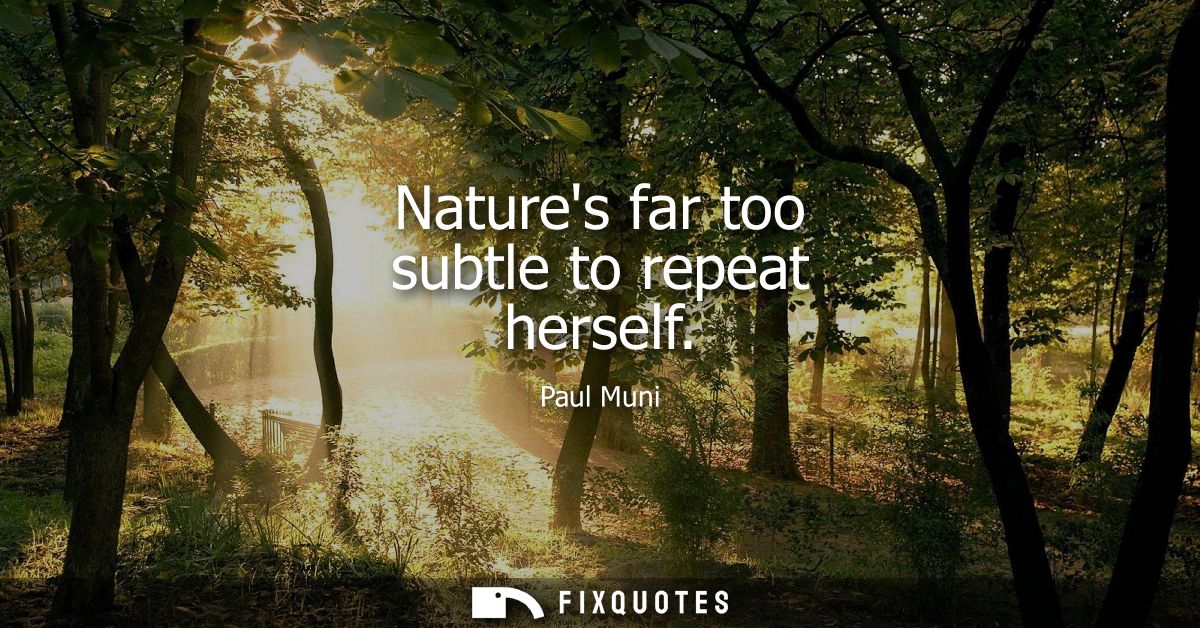
"Nature's far too subtle to repeat herself"
About this Quote
Paul Muni’s line honors the delicacy of difference. It points to a world where patterns recur, but never as copies. Leaves share a shape, yet no two are the same; snowflakes rhyme without repeating a verse. Evolution depends on this very refusal to duplicate, turning tiny variations into the engine of life. Even time participates: a river looks familiar, but its waters are never identical, its banks never precisely as they were.
From an artist like Muni, the thought carries an extra charge. He was known for dissolving into roles, refusing to play himself on repeat. Each character demanded a new posture, a new cadence, a new moral weather. The stage intensifies this reality: every performance, though scripted, is a one-time event, reshaped by air, audience, and accident. To honor nature is to resist habit, to reject the comfort of stock responses and canned feelings. Subtlety forbids the shortcut.
The remark also presses against our hunger for formulas. Science thrives on models, but the best scientists hold them lightly, aware that reality exceeds any schema. Chaotic systems make this humility unavoidable; sensitivity to initial conditions ensures that outcomes, though constrained, never exactly recur. History, too, echoes rather than repeats. We see cycles and analogies, but context twists the melody into a new tune.
There is an ethical edge here. If nature does not repeat herself, then people should not be treated as categories. Each person is a singular convergence of inheritance, experience, and circumstance. Listening becomes a form of accuracy. So does leadership, teaching, caregiving, and craft: attention to the particular over the generic, the live situation over the brittle rule.
Finally, the line counsels release. Stop trying to relive a peak moment or reproduce a past success. Attend to what is unfolding now. The world’s subtlety is an invitation to continual discovery, not a puzzle to be solved once and for all.
From an artist like Muni, the thought carries an extra charge. He was known for dissolving into roles, refusing to play himself on repeat. Each character demanded a new posture, a new cadence, a new moral weather. The stage intensifies this reality: every performance, though scripted, is a one-time event, reshaped by air, audience, and accident. To honor nature is to resist habit, to reject the comfort of stock responses and canned feelings. Subtlety forbids the shortcut.
The remark also presses against our hunger for formulas. Science thrives on models, but the best scientists hold them lightly, aware that reality exceeds any schema. Chaotic systems make this humility unavoidable; sensitivity to initial conditions ensures that outcomes, though constrained, never exactly recur. History, too, echoes rather than repeats. We see cycles and analogies, but context twists the melody into a new tune.
There is an ethical edge here. If nature does not repeat herself, then people should not be treated as categories. Each person is a singular convergence of inheritance, experience, and circumstance. Listening becomes a form of accuracy. So does leadership, teaching, caregiving, and craft: attention to the particular over the generic, the live situation over the brittle rule.
Finally, the line counsels release. Stop trying to relive a peak moment or reproduce a past success. Attend to what is unfolding now. The world’s subtlety is an invitation to continual discovery, not a puzzle to be solved once and for all.
Quote Details
| Topic | Nature |
|---|
More Quotes by Paul
Add to List