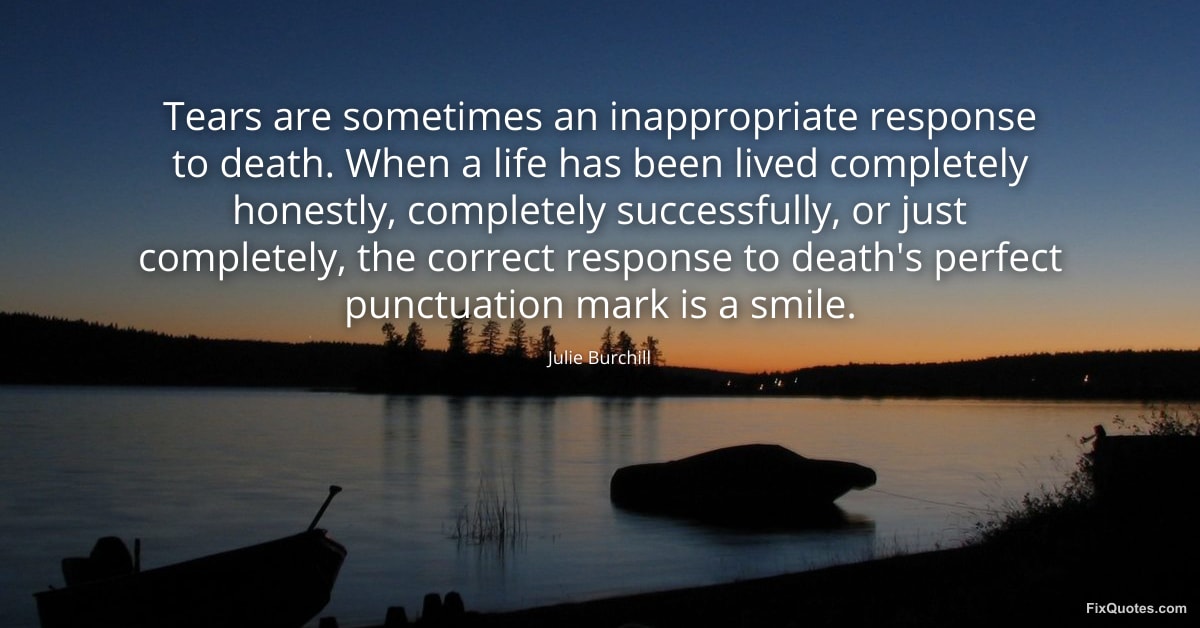
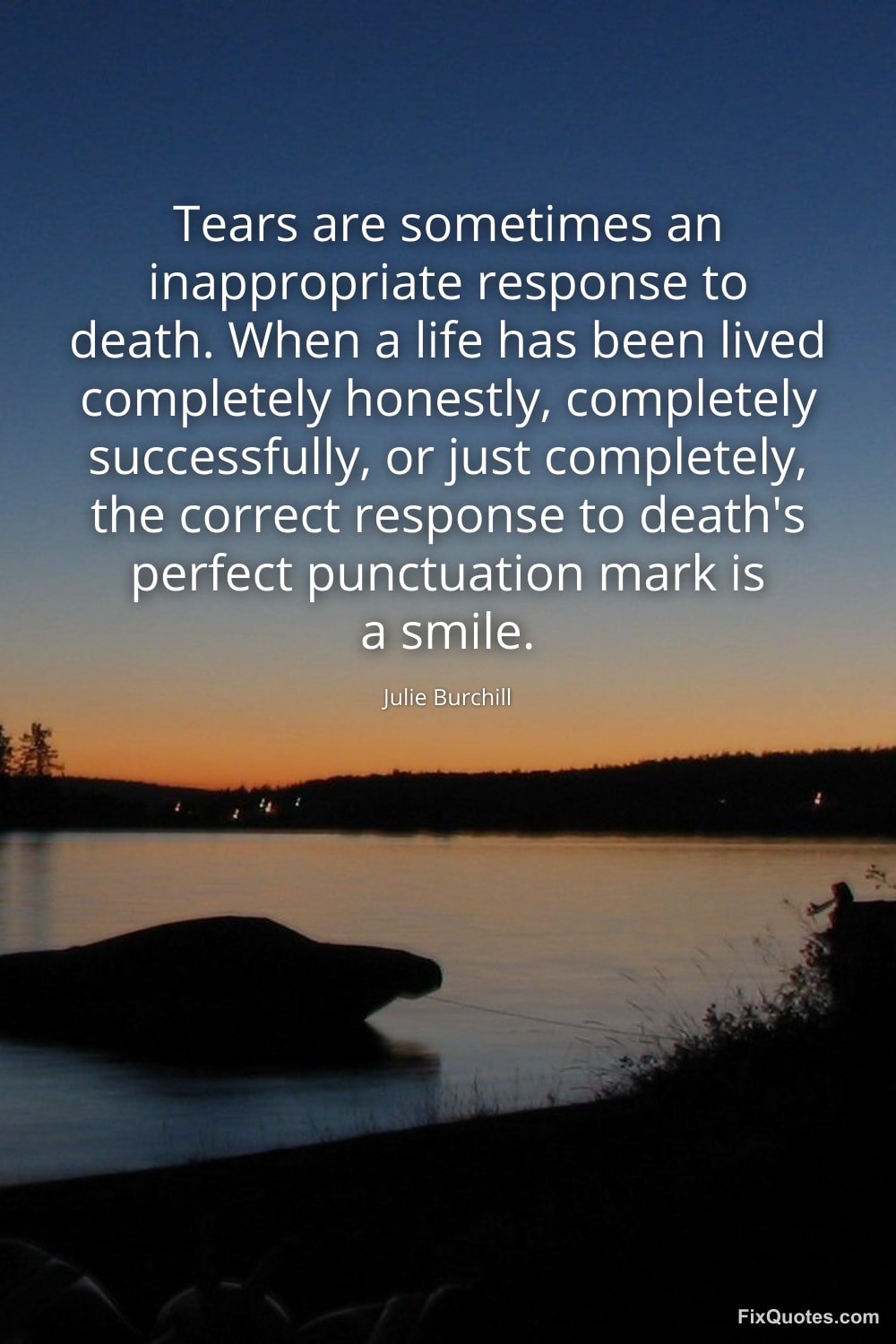
"Tears are sometimes an inappropriate response to death. When a life has been lived completely honestly, completely successfully, or just completely, the correct response to death's perfect punctuation mark is a smile"
About this Quote
Burchill’s line is engineered to scandalize our reflexes. It doesn’t deny grief so much as rebuke the social script that treats tears as the only respectable proof of love. By calling tears “sometimes inappropriate,” she’s policing sentimentality, pushing back against the Victorian inheritance that equates public mourning with moral seriousness. The provocation works because it dares you to imagine a death that isn’t primarily a rupture but a completed sentence.
The phrase “death’s perfect punctuation mark” is classic Burchill: clever, cold-blooded, and oddly consoling. Punctuation implies structure, intention, even style. It reframes death from cosmic injustice to editorial inevitability. That’s not comfort for everyone; it’s comfort for people who need meaning more than mercy. The insistence on “completely” (honestly, successfully, or just completely) widens the gate. Success is optional; authenticity is ideal; sheer fullness is enough. She’s constructing an anti-tragedy: a life you don’t have to apologize for at the end.
Subtextually, it’s also an attack on performative grief. A smile becomes the radical alternative to the grief-industrial expectations of collapse, the curated eulogies, the competitive sorrow. Yet the line keeps its own escape hatch: “sometimes.” Burchill knows the risk of sounding cruel. She’s arguing for emotional accuracy, not emotional austerity: if someone lived with candor and appetite, the honest tribute may be gratitude, not wet-eyed theater.
The phrase “death’s perfect punctuation mark” is classic Burchill: clever, cold-blooded, and oddly consoling. Punctuation implies structure, intention, even style. It reframes death from cosmic injustice to editorial inevitability. That’s not comfort for everyone; it’s comfort for people who need meaning more than mercy. The insistence on “completely” (honestly, successfully, or just completely) widens the gate. Success is optional; authenticity is ideal; sheer fullness is enough. She’s constructing an anti-tragedy: a life you don’t have to apologize for at the end.
Subtextually, it’s also an attack on performative grief. A smile becomes the radical alternative to the grief-industrial expectations of collapse, the curated eulogies, the competitive sorrow. Yet the line keeps its own escape hatch: “sometimes.” Burchill knows the risk of sounding cruel. She’s arguing for emotional accuracy, not emotional austerity: if someone lived with candor and appetite, the honest tribute may be gratitude, not wet-eyed theater.
Quote Details
| Topic | Mortality |
|---|
More Quotes by Julie
Add to List