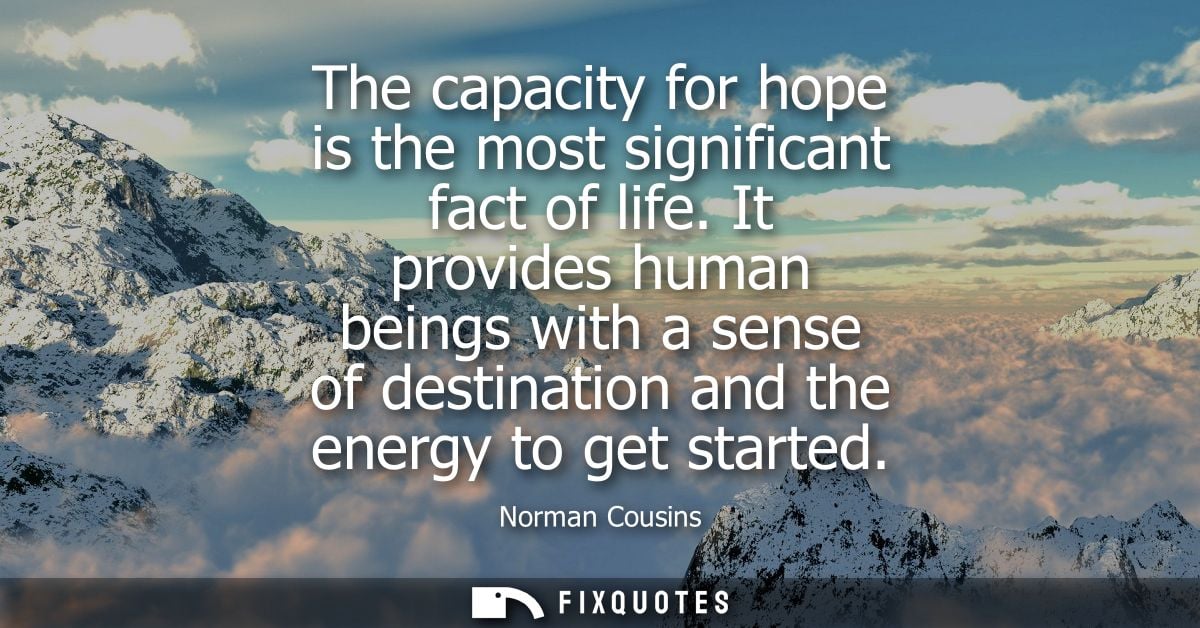
"The capacity for hope is the most significant fact of life. It provides human beings with a sense of destination and the energy to get started"
About this Quote
Hope, for Norman Cousins, isn’t a Hallmark mood; it’s an engine. Calling it “the most significant fact of life” is deliberately provocative, a reframing that elevates an internal posture to the level of biology or history. Cousins wants hope to read as evidence: proof that humans aren’t just creatures who endure, but creatures who project themselves forward. The sentence is built like a practical argument, not a prayer. “Capacity” implies something trainable, even communal, rather than a lucky personality trait. He’s smuggling in a democratic idea: if hope is a capacity, it can be cultivated and protected.
The subtext is a critique of paralysis. Cousins distinguishes between two things that often get conflated: a “sense of destination” (meaning, direction, purpose) and “the energy to get started” (activation). He’s not praising optimism; he’s explaining ignition. That matters because people rarely fail from lack of information. They fail from the dead weight of futility. Hope, in his framing, is a technology that converts uncertainty into motion.
Context sharpens the stakes. Cousins was a mid-century public intellectual who wrote about politics, peace, and famously, illness and recovery. In an era shadowed by nuclear anxiety and institutional distrust, he’s arguing that the decisive human advantage is not certainty but forward momentum. The line reads like a secular pep talk with moral consequences: societies that can still imagine a destination are the ones that can mobilize, rebuild, and resist cynicism’s easy glamour.
The subtext is a critique of paralysis. Cousins distinguishes between two things that often get conflated: a “sense of destination” (meaning, direction, purpose) and “the energy to get started” (activation). He’s not praising optimism; he’s explaining ignition. That matters because people rarely fail from lack of information. They fail from the dead weight of futility. Hope, in his framing, is a technology that converts uncertainty into motion.
Context sharpens the stakes. Cousins was a mid-century public intellectual who wrote about politics, peace, and famously, illness and recovery. In an era shadowed by nuclear anxiety and institutional distrust, he’s arguing that the decisive human advantage is not certainty but forward momentum. The line reads like a secular pep talk with moral consequences: societies that can still imagine a destination are the ones that can mobilize, rebuild, and resist cynicism’s easy glamour.
Quote Details
| Topic | Hope |
|---|
More Quotes by Norman
Add to List