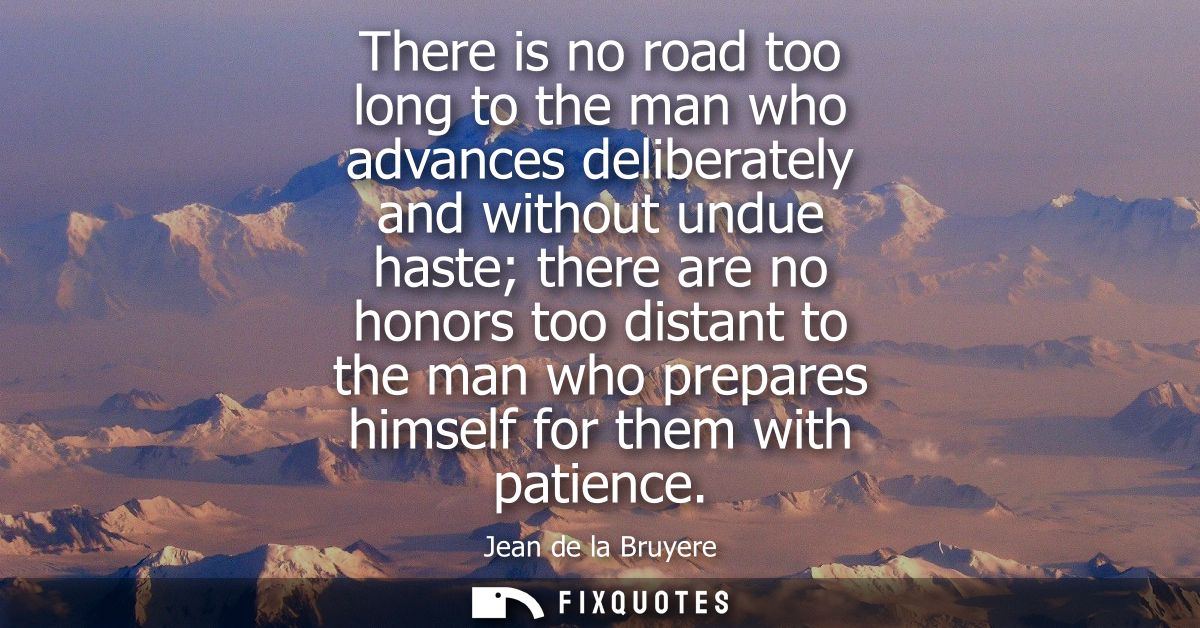
"There is no road too long to the man who advances deliberately and without undue haste; there are no honors too distant to the man who prepares himself for them with patience"
About this Quote
The sentence is built on a pair of absolutes: "no road too long", "no honors too distant". That certainty is rhetorical bait. It flatters the reader into thinking endurance guarantees arrival, then quietly shifts the burden onto character. The phrase "deliberately and without undue haste" isn't about speed; it's about governance of the self. "Undue" is the needle: some haste is acceptable, even necessary, but the wrong kind exposes anxiety, greed, or inexperience.
"Prepares himself" sharpens the subtext. Honors aren't merely awarded; they are met. La Bruyere implies that rank should be the consequence of cultivation, not the prize that substitutes for it. Patience here is less a moral halo than a strategy: keep working, keep learning, keep your face still. In a world where reputations were made and ruined by a glance, the slow mover looked serious, inevitable, and therefore worthy of being promoted.
Quote Details
| Topic | Perseverance |
|---|---|
| Source | Jean de La Bruyère, Les Caractères (The Characters) — English rendering of a passage commonly cited; see Wikiquote entry for citation. |
| Cite |
Citation Formats
APA Style (7th ed.)
Bruyère, Jean de La. (2026, January 15). There is no road too long to the man who advances deliberately and without undue haste; there are no honors too distant to the man who prepares himself for them with patience. FixQuotes. https://fixquotes.com/quotes/there-is-no-road-too-long-to-the-man-who-advances-36488/
Chicago Style
Bruyère, Jean de La. "There is no road too long to the man who advances deliberately and without undue haste; there are no honors too distant to the man who prepares himself for them with patience." FixQuotes. January 15, 2026. https://fixquotes.com/quotes/there-is-no-road-too-long-to-the-man-who-advances-36488/.
MLA Style (9th ed.)
"There is no road too long to the man who advances deliberately and without undue haste; there are no honors too distant to the man who prepares himself for them with patience." FixQuotes, 15 Jan. 2026, https://fixquotes.com/quotes/there-is-no-road-too-long-to-the-man-who-advances-36488/. Accessed 12 Feb. 2026.