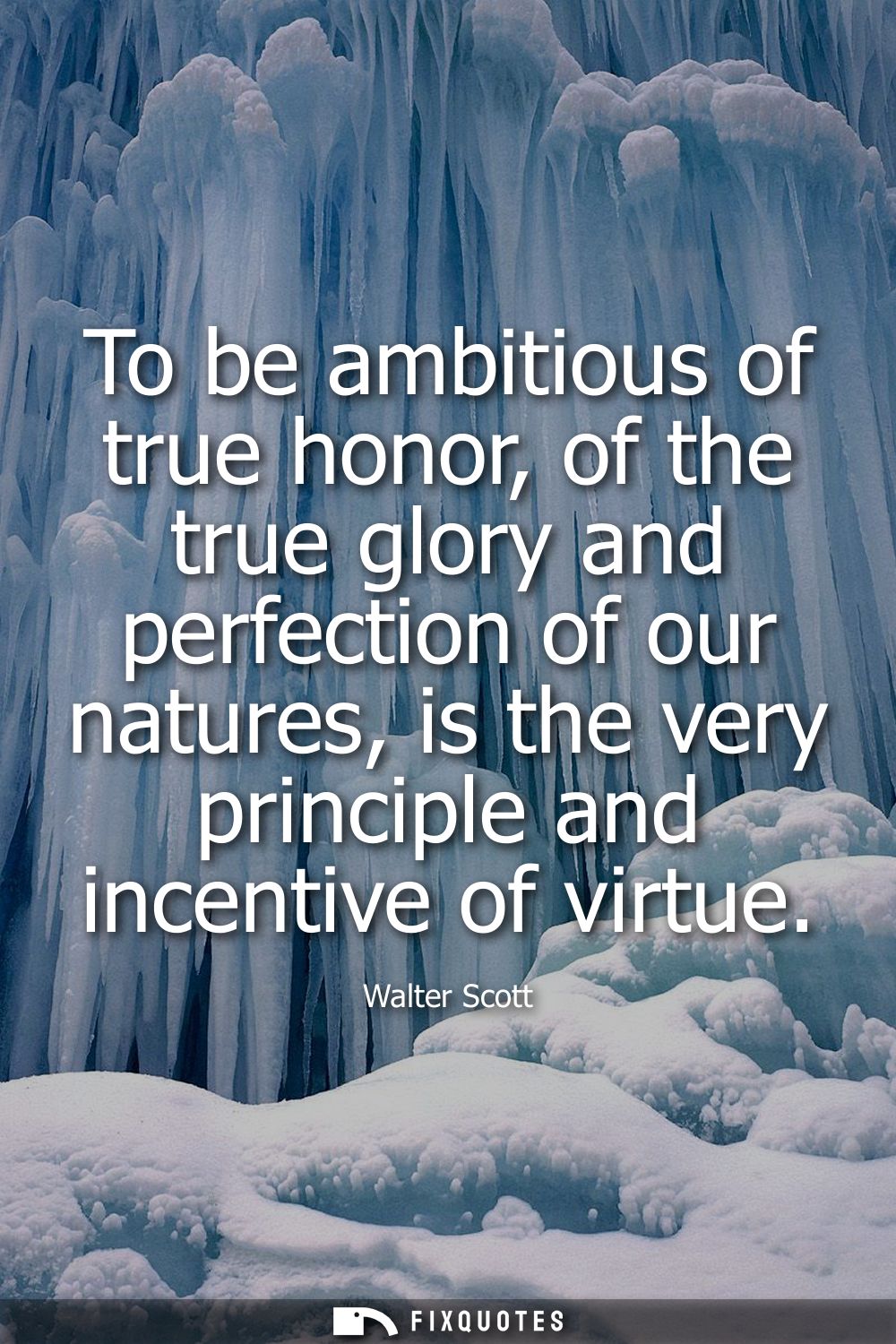
"To be ambitious of true honor, of the true glory and perfection of our natures, is the very principle and incentive of virtue"
About this Quote
Walter Scott links the restless energy of ambition to the making of a good life, provided the aim is right. To be ambitious of true honor is to hunger not for applause, titles, or the glitter of success, but for integrity that withstands scrutiny. True glory here means merit that would be worthy even if no crowd were watching, and the perfection of our natures points to the full development of our best capacities: courage disciplined by justice, loyalty tempered by conscience, vigor guided by wisdom. When ambition is ordered toward such ends, it does not threaten virtue; it becomes its engine.
Scott wrote in the Romantic era yet drew deeply from classical and chivalric ideals. His novels repeatedly stage the tension between hollow reputation and substantive character. Characters who chase spectacle or factional triumphs tend to falter; those who aim at honor grounded in duty and truth grow into themselves, often at personal cost. The contrast clarifies his claim: wrongly aimed ambition inflates the ego and corrodes judgment, while rightly aimed ambition gathers the will, steadies choice, and energizes sacrifice. It becomes both principle, in the sense of a guiding standard, and incentive, in the sense of a powerful motive to act well.
There is a social dimension too. Honor is not merely private feeling; it is a way of living that can be recognized by a community because it produces reliable goods: trustworthiness, fairness, courage under pressure. Yet the recognition is secondary. What matters is that the aim matches what is truly noble in human nature. The admonition is therefore not to dampen ambition but to purify it. Desire greatness, but let greatness mean fidelity to what is right and the patient cultivation of excellence. Then ambition does not lure one away from virtue; it is the steady spur that keeps one moving toward it.
Scott wrote in the Romantic era yet drew deeply from classical and chivalric ideals. His novels repeatedly stage the tension between hollow reputation and substantive character. Characters who chase spectacle or factional triumphs tend to falter; those who aim at honor grounded in duty and truth grow into themselves, often at personal cost. The contrast clarifies his claim: wrongly aimed ambition inflates the ego and corrodes judgment, while rightly aimed ambition gathers the will, steadies choice, and energizes sacrifice. It becomes both principle, in the sense of a guiding standard, and incentive, in the sense of a powerful motive to act well.
There is a social dimension too. Honor is not merely private feeling; it is a way of living that can be recognized by a community because it produces reliable goods: trustworthiness, fairness, courage under pressure. Yet the recognition is secondary. What matters is that the aim matches what is truly noble in human nature. The admonition is therefore not to dampen ambition but to purify it. Desire greatness, but let greatness mean fidelity to what is right and the patient cultivation of excellence. Then ambition does not lure one away from virtue; it is the steady spur that keeps one moving toward it.
Quote Details
| Topic | Ethics & Morality |
|---|
More Quotes by Walter
Add to List