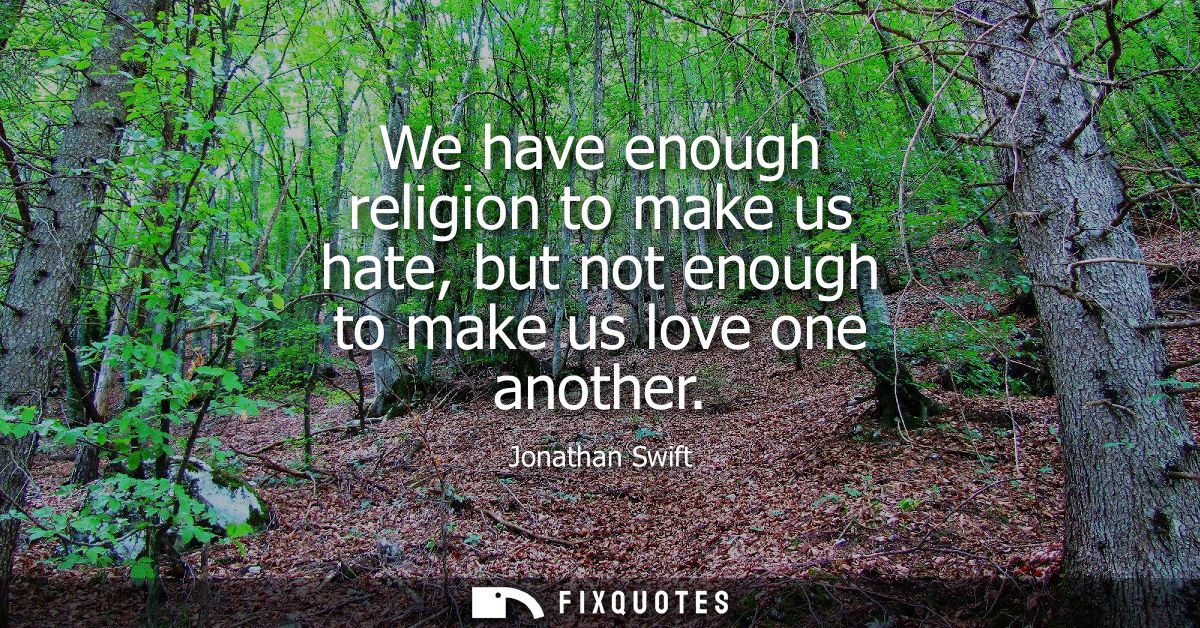
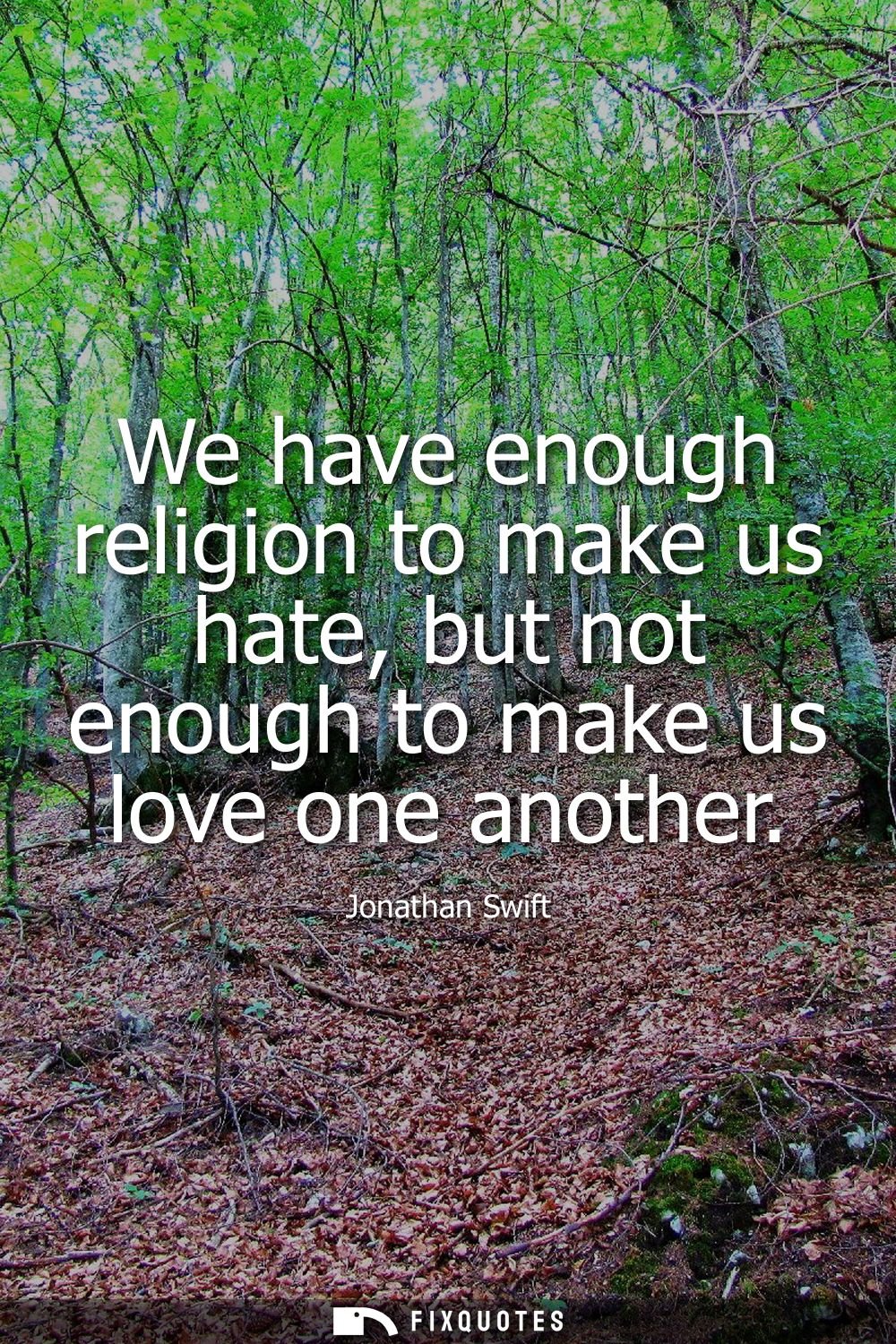
"We have enough religion to make us hate, but not enough to make us love one another"
About this Quote
Swift is doing what he does best: slicing piety down the middle and letting the hypocrisy spill out. The line turns on a neat imbalance - “enough” religion for hatred, “not enough” for love - and the arithmetic is the insult. He’s not attacking faith as an abstract good; he’s attacking the version of religion that functions as a social weapon, a badge of belonging sharp enough to cut outsiders but too thin to nourish compassion.
The subtext is brutally modern: religion, in practice, often gets optimized for identity and grievance. It supplies ready-made categories (“us” versus “them”), moral certainty, and the intoxicating permission to despise. Swift frames hate as the easier, more socially rewarded output of public religiosity, while love is cast as the harder, less convenient demand - the part that would actually require sacrifice, humility, and restraint. The line implies that people haven’t failed religion accidentally; they’ve selectively adopted the parts that flatter their worst instincts.
Context matters. Swift writes from a Britain and Ireland roiled by sectarian conflict, where Protestant-Catholic antagonism shaped laws, livelihoods, and daily suspicion. As an Anglican cleric and a master satirist, he’s uniquely positioned to indict his own side without pretending neutrality. The sting is that he treats “religion” less like revelation and more like a civic technology: it can organize communities, yes, but it can also manufacture enemies.
What makes the line work is its moral jiu-jitsu. Swift doesn’t preach love; he exposes how loudly we profess it while engineering institutions that reward its opposite.
The subtext is brutally modern: religion, in practice, often gets optimized for identity and grievance. It supplies ready-made categories (“us” versus “them”), moral certainty, and the intoxicating permission to despise. Swift frames hate as the easier, more socially rewarded output of public religiosity, while love is cast as the harder, less convenient demand - the part that would actually require sacrifice, humility, and restraint. The line implies that people haven’t failed religion accidentally; they’ve selectively adopted the parts that flatter their worst instincts.
Context matters. Swift writes from a Britain and Ireland roiled by sectarian conflict, where Protestant-Catholic antagonism shaped laws, livelihoods, and daily suspicion. As an Anglican cleric and a master satirist, he’s uniquely positioned to indict his own side without pretending neutrality. The sting is that he treats “religion” less like revelation and more like a civic technology: it can organize communities, yes, but it can also manufacture enemies.
What makes the line work is its moral jiu-jitsu. Swift doesn’t preach love; he exposes how loudly we profess it while engineering institutions that reward its opposite.
Quote Details
| Topic | Faith |
|---|
More Quotes by Jonathan
Add to List