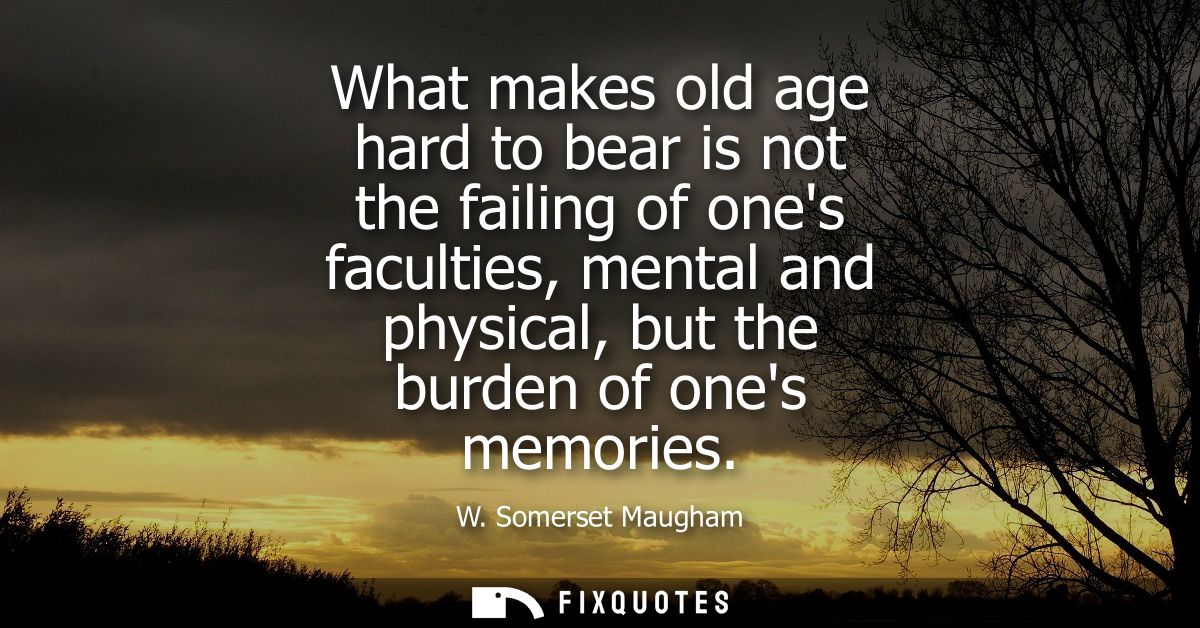
"What makes old age hard to bear is not the failing of one's faculties, mental and physical, but the burden of one's memories"
About this Quote
Maugham’s line cuts against the sentimental story we like to tell about aging: that the tragedy is purely mechanical, a body and mind gradually losing their edge. He’s too unsparing for that. The real weight, he suggests, is archival. Old age is hard not because you can’t do as much, but because you remember too much, and you can’t edit it down.
The subtext is almost cruel in its clarity: memory isn’t a warm scrapbook; it’s an accumulating ledger. As your future shrinks, the past stops being prologue and becomes the main event, replaying with fewer distractions available to blunt it. The “burden” isn’t just nostalgia; it’s regret, missed chances, betrayals you committed or absorbed, the embarrassing reruns of former selves. Even happiness can get heavy when you know it’s over and can’t be retrieved except as a reconstruction.
As a playwright and novelist who made a career out of unsparing psychological realism, Maugham understood that the mind is rarely a sanctuary. His characters often live in the aftershocks of choices, trapped between self-knowledge and self-deception. Written in the shadow of two world wars and a rapidly dissolving Victorian moral order, the line also carries historical grit: longevity means surviving more wreckage, personal and collective. It’s a bleak insight, but it’s also oddly humanizing. It refuses the easy pity of decline and instead points to the harder problem: what it means to live long enough to remember.
The subtext is almost cruel in its clarity: memory isn’t a warm scrapbook; it’s an accumulating ledger. As your future shrinks, the past stops being prologue and becomes the main event, replaying with fewer distractions available to blunt it. The “burden” isn’t just nostalgia; it’s regret, missed chances, betrayals you committed or absorbed, the embarrassing reruns of former selves. Even happiness can get heavy when you know it’s over and can’t be retrieved except as a reconstruction.
As a playwright and novelist who made a career out of unsparing psychological realism, Maugham understood that the mind is rarely a sanctuary. His characters often live in the aftershocks of choices, trapped between self-knowledge and self-deception. Written in the shadow of two world wars and a rapidly dissolving Victorian moral order, the line also carries historical grit: longevity means surviving more wreckage, personal and collective. It’s a bleak insight, but it’s also oddly humanizing. It refuses the easy pity of decline and instead points to the harder problem: what it means to live long enough to remember.
Quote Details
| Topic | Aging |
|---|
More Quotes by Somerset Maugham
Add to List