
George Washington Biography Quotes 50 Report mistakes
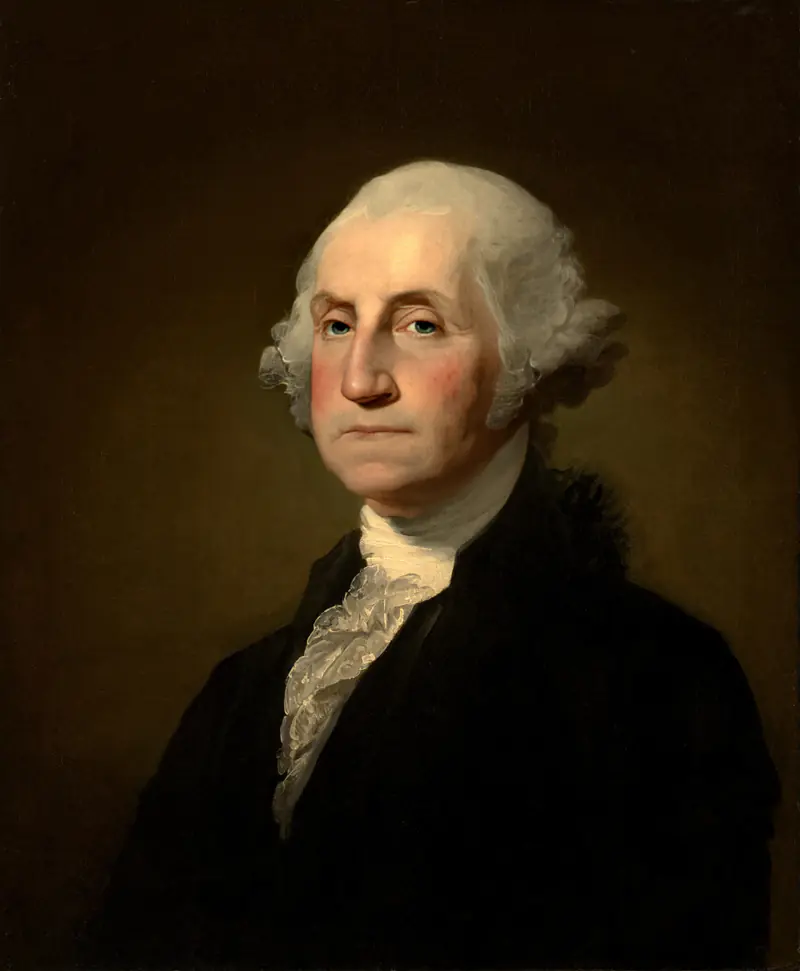
| 50 Quotes | |
| Occup. | President |
| From | USA |
| Born | February 22, 1732 |
| Died | December 14, 1799 |
| Aged | 67 years |
George Washington was born on February 22, 1732, at Popes Creek in Westmoreland County, Virginia, into the tidewater gentry of the British Atlantic world. His father, Augustine Washington, died when George was eleven, leaving him a patchwork inheritance but not the great estates that went to older half-brothers. The loss forced an early seriousness: he learned to read the weather, men, and money, and he learned that authority had to be earned in a household that quickly reorganized around new marriages, new guardianships, and shifting property lines.
He came of age in an economy built on tobacco, land speculation, and enslaved labor - a system he benefited from and later managed with ruthless attention to detail. Yet the boy who copied rules of civility into a notebook also learned how easily reputation could be ruined and how quickly fortune could turn. The young Washington developed a lifelong habit of self-command: emotion moved behind the mask of procedure, and ambition disguised itself as duty.
Education and Formative Influences
Washington had no university education; his training was practical, mathematical, and relentlessly worldly. As a teenager he studied surveying and, through the patronage of the powerful Fairfax family, began mapping the Virginia frontier - work that taught him measurement, negotiation, and the hard limits of imperial control beyond the tidewater. His half-brother Lawrence shaped his early identity through the social polish of Mount Vernon and the military aura of Britain, while Washingtons own reading - geography, agriculture, military manuals, and later Enlightenment political thought - sharpened into a creed of improvement: discipline, credit, and infrastructure were moral as well as material goods.
Career, Major Works, and Turning Points
Washingtons public life began in the crucible of the French and Indian War: as a young officer he carried Virginias ambitions into the Ohio Valley, survived disaster at Fort Necessity (1754), and learned endurance amid British condescension and provincial chaos; his later command under General Braddock exposed him to both European tactics and their failures in American terrain. After returning to Mount Vernon as a planter and Burgess, he moved from protest to revolution as imperial taxation and coercion sharpened; in 1775 Congress chose him as commander in chief, a selection as political as it was military. His greatest achievement was not tactical brilliance but the creation of a functioning army through winters like Valley Forge, the containment of civilian-military conflict, and the strategic patience that made Yorktown (1781) possible with French aid. Resigning his commission in 1783 signaled a new kind of power: legitimacy grounded in restraint. Alarmed by the weak Articles of Confederation, he presided over the Constitutional Convention (1787), then became the first US president (1789-1797), building executive precedent, a cabinet system, fiscal foundations with Hamilton, neutrality in European wars, and a fragile balance amid the Whiskey Rebellion and bitter party formation. His Farewell Address distilled his anxieties: faction, foreign entanglements, and the corrosion of public virtue.
Philosophy, Style, and Themes
Washingtons inner life was a study in controlled intensity. He craved honor, feared disorder, and believed that institutions must outlast personalities - including his own. That is why he framed politics less as persuasion than as containment: "Government is not reason; it is not eloquent; it is force. Like fire, it is a dangerous servant and a fearful master". The sentence is revealing not only as theory but as self-portrait - a man who understood power as necessary heat, always threatening to burn, and therefore requiring strict habits, clear lines of authority, and personal restraint.
His style was ceremonially republican: public distance, private calculation, and a preference for rules over improvisation. In war and statecraft he treated discipline as the bridge between imperfect human nature and workable liberty; he could admire popular sovereignty while doubting popular steadiness. He warned against theatrical virtue because he had seen how ambition hides behind flags: "Guard against the impostures of pretended patriotism". And in foreign policy he turned a hard-earned skepticism into a moral command for a weak new nation that could not afford romantic crusades: "Observe good faith and justice toward all nations. Cultivate peace and harmony with all". The themes that recur - order, credibility, moderation, and reputation - are the psychic architecture of a leader who knew that the Revolution could devour itself.
Legacy and Influence
Washington died on December 14, 1799, at Mount Vernon, and almost immediately became both a national symbol and a contested human being: the indispensable founder and the enslaver who postponed emancipation until his will. His enduring influence lies in precedents that still govern the presidency - civilian control of the military, the legitimacy of stepping away from power, the expectation that the executive represents the whole union rather than a faction - and in a political vocabulary that links liberty to self-restraint. Later generations have revised his marble image into something sharper: a leader forged by empire, frontier, and civil war-in-waiting, whose greatest strength was not perfection but an unusually sustained ability to subordinate ego to the survival of an experiment.
Our collection contains 50 quotes who is written by George, under the main topics: Ethics & Morality - Wisdom - Justice - Friendship - Leadership.
Other people realated to George: Thomas Paine (Writer), George Mason (Statesman), Washington Irving (Writer), Alexander Hamilton (Politician), John Quincy Adams (President), James Monroe (President), James Baldwin (Educator), Henry W. Longfellow (Poet), Ezra Stiles (Clergyman), Mercy Otis Warren (Playwright)
George Washington Famous Works
- 1796 George Washington's Farewell Address (Speech)
- 1748 George Washington's Journal (Diary)
- 1745 Rules of Civility & Decent Behaviour In Company and Conversation (Book)
Source / external links