
Joseph Stalin Biography Quotes 25 Report mistakes
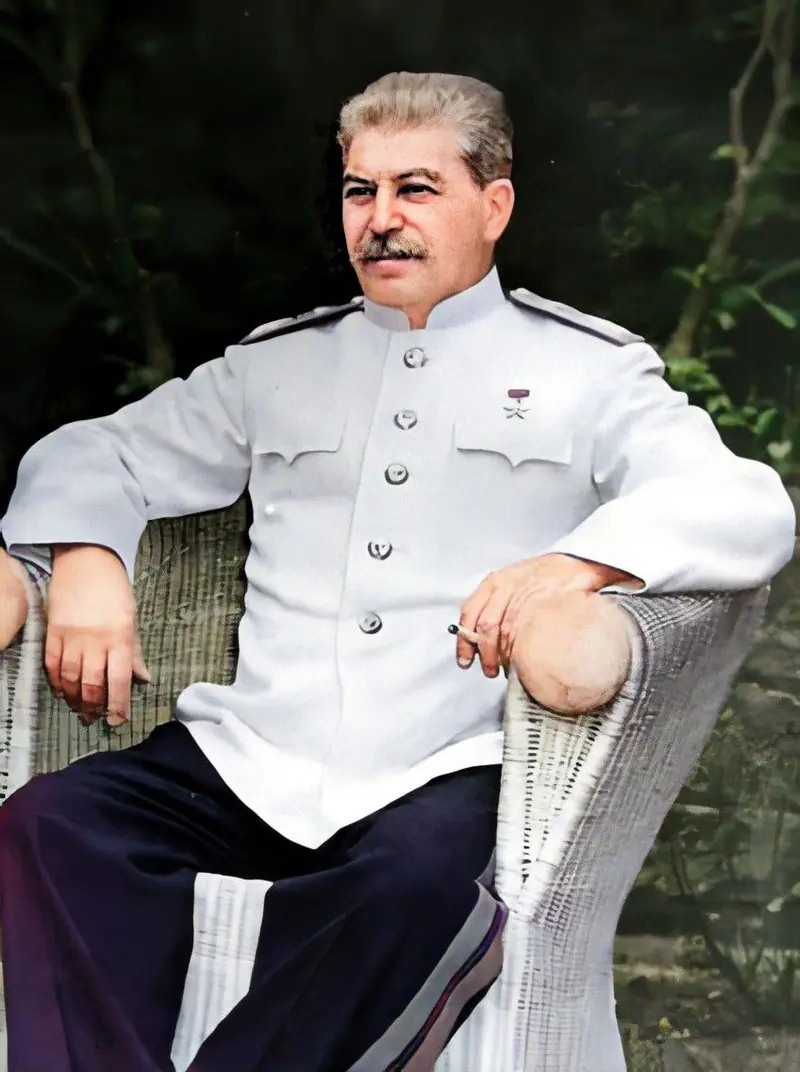
| 25 Quotes | |
| Born as | Losif Vissarionovich Dzhugashvili |
| Known as | Joseph Vissarionovich Stalin |
| Occup. | Leader |
| From | Russia |
| Born | December 21, 1879 Gori, Tiflis Governorate, Russian Empire |
| Died | March 5, 1953 Kuntsevo Dacha near Moscow, Russian SFSR, Soviet Union |
| Aged | 73 years |
Joseph Stalin was born Losif Vissarionovich Dzhugashvili on 1879-12-21 in Gori, a small town in the Russian Empire's Georgian lands, and died on 1953-03-05 near Moscow after ruling the Soviet Union for roughly a quarter century. His childhood unfolded in the borderlands of empire: Georgian speech and Orthodox piety under Russian administration, a setting that trained him early in the art of navigating overlapping loyalties and coercive power.
His family life was unstable. His father, a cobbler, slid into alcoholism and violence and drifted away; his mother, determined and devout, pushed her son toward the priesthood as an escape from poverty. The boy's physical vulnerabilities - a childhood bout of smallpox that scarred his face and a later injury that left his left arm impaired - sharpened a self-protective temperament and a habit of masking feeling behind watchfulness, traits that later hardened into political method.
Education and Formative Influences
Stalin studied at the Gori Church School and then the Tiflis (Tbilisi) Theological Seminary, where he absorbed the discipline of clerical education while simultaneously rebelling against it. Seminary rules, informers, and punishment acquainted him with institutional surveillance; banned literature introduced him to Marxism and the underground. By the late 1890s he had moved from religious vocation to revolutionary identity, joining Social Democratic circles and learning the clandestine skills - aliases, coded communication, and compartmentalized trust - that would define his rise.
Career, Major Works, and Turning Points
After entering the Bolshevik faction, Stalin became a professional revolutionary in the Caucasus: organizing strikes, editing propaganda, fundraising through "expropriations" (including the 1907 Tiflis bank robbery), and enduring repeated arrests, Siberian exiles, and escapes. He was in Petrograd for 1917, and after the Bolshevik seizure of power heFANYIITIONS and the civil war he served in top administrative and military-political roles, building a reputation for ruthless decisiveness. In 1922 Lenin appointed him General Secretary, a post Stalin transformed into the command center of appointments and discipline; after Lenin's death (1924) he outmaneuvered rivals - first Trotsky, then Zinoviev and Kamenev, then Bukharin - and by the end of the 1920s imposed "socialism in one country". The early 1930s brought forced collectivization and rapid industrialization under Five-Year Plans, with catastrophic famine in parts of the countryside, especially Ukraine. The Great Terror of 1936-1938 reshaped the party, state, and army through show trials, purges, and mass operations. In foreign affairs he signed the 1939 Molotov-Ribbentrop Pact, then led the USSR through the German invasion of 1941, recasting himself as wartime supreme commander as the Red Army bled and then advanced to Berlin. After 1945 he consolidated a Soviet bloc, launched postwar reconstruction, and revived internal campaigns against alleged "enemies", dying in 1953 with succession unsettled and terror still a political instrument.
Philosophy, Style, and Themes
Stalin's inner life, as far as it can be traced through memoirs, archives, and his own texts, suggests a man who fused insecurity with an extreme demand for control. He cultivated an image of plainness and discipline, yet he also staged politics as theater: ritualized congresses, scripted confessions, and a cult that presented him as the infallible interpreter of history. His personal suspicion became state doctrine; the sentiment "I trust no one, not even myself". captures the psychological engine of a system where loyalty was never proved once and for all, only constantly revalidated under threat.
His governing philosophy treated power as measurable force - organizational, military, and informational - and morality as subordinate to outcomes. The remark "The only real power comes out of a long rifle". aligns with his preference for coercive capacity: police files, party кадровая policy, and the army were not merely tools but the grammar of politics. He distrusted independent authority, especially spiritual or transnational claims; the sardonic question "The Pope? How many divisions has he got?" reveals a worldview in which legitimacy is cashable only in institutions that can compel. Under that logic, language itself became a weapon: ideological deviation was treated as sabotage, history rewritten, and fear engineered into a predictable administrative output.
Legacy and Influence
Stalin left a paradoxical inheritance: the USSR emerged as an industrial and military superpower that had borne the decisive weight of defeating Nazi Germany, yet the human cost of his transformation was staggering - mass famine, deportations, labor camps, and political executions that scarred entire societies and moral vocabularies. After his death, Khrushchev's denunciation of the "cult of personality" began an uneven de-Stalinization, but Stalinism persisted as a template for centralized rule: the fusion of party and state, the managerial use of terror, and the manipulation of truth through propaganda. His influence endures in debates over modernization by coercion, in the memorial battles across Russia and Eastern Europe, and in the cautionary language of politics worldwide, where his name remains shorthand for the point at which power stops pretending to be accountable.
Our collection contains 25 quotes who is written by Joseph, under the main topics: Motivational - Ethics & Morality - Justice - Writing - Dark Humor.
Other people realated to Joseph: Aleksandr Solzhenitsyn (Author), Winston Churchill (Statesman), Franklin D. Roosevelt (President), Vladimir Lenin (Leader), Leon Trotsky (Revolutionary), H.G. Wells (Author), Harry S. Truman (President), Nikita Khrushchev (Statesman), Ho Chi Minh (Revolutionary), Mikhail Gorbachev (Statesman)
Joseph Stalin Famous Works
- 1952 Economic Problems of Socialism in the USSR (Book)
- 1952 Speeches at the 19th Party Congress (Book)
- 1934 Problems of Leninism (Book)
- 1924 The Foundations of Leninism (Book)
- 1913 Marxism and the National Question (Book)
Source / external links