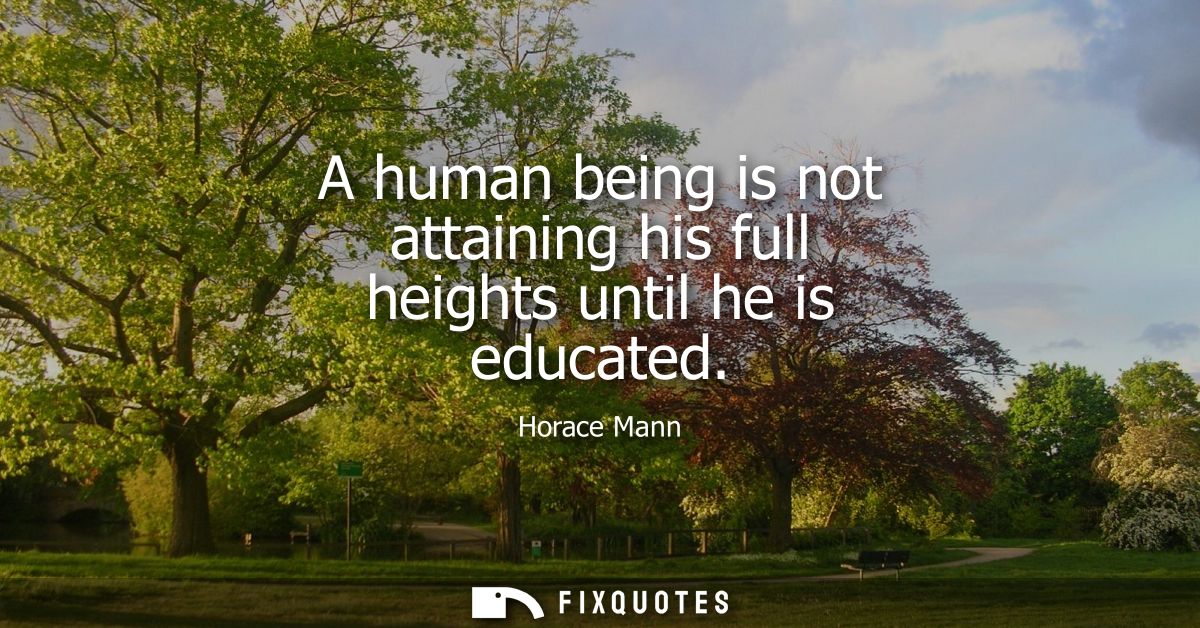
"A human being is not attaining his full heights until he is educated"
About this Quote
Horace Mann stakes a bold claim: human potential remains stunted until shaped by education. The phrase "full heights" points beyond job training or rote literacy to the full stature of a person: the development of reason, conscience, civic awareness, imagination, and the habits that allow a free individual to act with judgment and purpose. Education, in this sense, is not mere accumulation of facts but the disciplined awakening of capacities that otherwise lie dormant.
Mann spoke from the furnace of the early American republic, when industrialization, immigration, and widening inequality were remaking society. As the first secretary of the Massachusetts Board of Education, he led the common school movement, arguing for tax-supported, universal, nonsectarian schools with trained teachers and standardized curricula. He saw public education as the republics life-support: without educated citizens, democracy decays into manipulation by demagogues and rule by private interests. Schools, he believed, could be the great equalizer, preventing social ills before they arise by equipping children with moral sense and practical skills.
His vision defined education broadly. Intellectual rigor was joined to moral formation, civics, and even physical health. He believed ignorance narrows freedom, because people who cannot interpret the world become dependent on others to tell them what is true. Education enlarges freedom by cultivating discernment, empathy, and the power to revise ones own beliefs in light of evidence.
There are tensions in his legacy. Common schools also carried Protestant norms and expectations that pressured cultural minorities. The language of "full heights" can slip into a single standard of worth. Yet the core conviction remains potent: equal access to high-quality learning is a precondition for personal dignity and social self-government. In an age of information overload and polarized public life, Manns claim still challenges us to invest in education not only for economic growth but for the formation of capable, ethical, self-directed persons.
Mann spoke from the furnace of the early American republic, when industrialization, immigration, and widening inequality were remaking society. As the first secretary of the Massachusetts Board of Education, he led the common school movement, arguing for tax-supported, universal, nonsectarian schools with trained teachers and standardized curricula. He saw public education as the republics life-support: without educated citizens, democracy decays into manipulation by demagogues and rule by private interests. Schools, he believed, could be the great equalizer, preventing social ills before they arise by equipping children with moral sense and practical skills.
His vision defined education broadly. Intellectual rigor was joined to moral formation, civics, and even physical health. He believed ignorance narrows freedom, because people who cannot interpret the world become dependent on others to tell them what is true. Education enlarges freedom by cultivating discernment, empathy, and the power to revise ones own beliefs in light of evidence.
There are tensions in his legacy. Common schools also carried Protestant norms and expectations that pressured cultural minorities. The language of "full heights" can slip into a single standard of worth. Yet the core conviction remains potent: equal access to high-quality learning is a precondition for personal dignity and social self-government. In an age of information overload and polarized public life, Manns claim still challenges us to invest in education not only for economic growth but for the formation of capable, ethical, self-directed persons.
Quote Details
| Topic | Learning |
|---|
More Quotes by Horace
Add to List