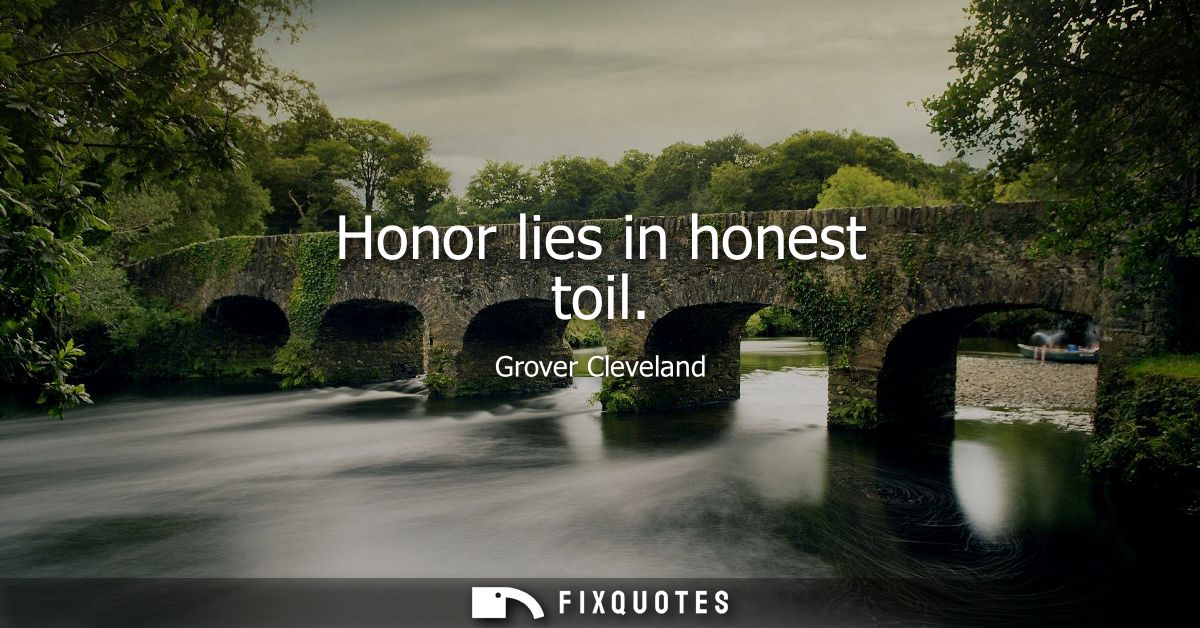
"Honor lies in honest toil"
About this Quote
"Honor lies in honest toil" is Cleveland’s moral hardball: a Victorian work ethic compressed into eight words, designed to sound less like a sermon than a standard. Coming from a president who branded himself as the antidote to Gilded Age rot, it’s a line that turns virtue into something measurable. Not pedigree, not charisma, not even success, just the steady credibility of work done without cheating.
The intent is political as much as personal. Cleveland governed in an era when fortunes were ballooning, patronage was a system, and the gap between industrial winners and everyone else was becoming impossible to sentimentalize. By tying honor to toil, he casts labor as the nation’s ethical backbone and quietly delegitimizes the leisure class’s claim to moral authority. It’s also a shot across the bow at corruption: the key word isn’t "toil" but "honest". Work alone doesn’t cleanse; integrity does. That qualifier narrows the definition of deservingness and gives Cleveland a language for reform without sounding revolutionary.
The subtext carries a harder edge. If honor is earned through honest toil, then those who don’t toil, or whose wealth comes from speculation, political favors, or exploitation, are morally suspect. It’s a populist posture that flatters workers while disciplining them too, implying that dignity is available, but only through compliance with a certain moral economy.
In Cleveland’s mouth, the phrase doubles as self-portrait: the straight-backed custodian of public trust, insisting that the republic should operate like a job you do cleanly, even when nobody’s watching.
The intent is political as much as personal. Cleveland governed in an era when fortunes were ballooning, patronage was a system, and the gap between industrial winners and everyone else was becoming impossible to sentimentalize. By tying honor to toil, he casts labor as the nation’s ethical backbone and quietly delegitimizes the leisure class’s claim to moral authority. It’s also a shot across the bow at corruption: the key word isn’t "toil" but "honest". Work alone doesn’t cleanse; integrity does. That qualifier narrows the definition of deservingness and gives Cleveland a language for reform without sounding revolutionary.
The subtext carries a harder edge. If honor is earned through honest toil, then those who don’t toil, or whose wealth comes from speculation, political favors, or exploitation, are morally suspect. It’s a populist posture that flatters workers while disciplining them too, implying that dignity is available, but only through compliance with a certain moral economy.
In Cleveland’s mouth, the phrase doubles as self-portrait: the straight-backed custodian of public trust, insisting that the republic should operate like a job you do cleanly, even when nobody’s watching.
Quote Details
| Topic | Work Ethic |
|---|
More Quotes by Grover
Add to List