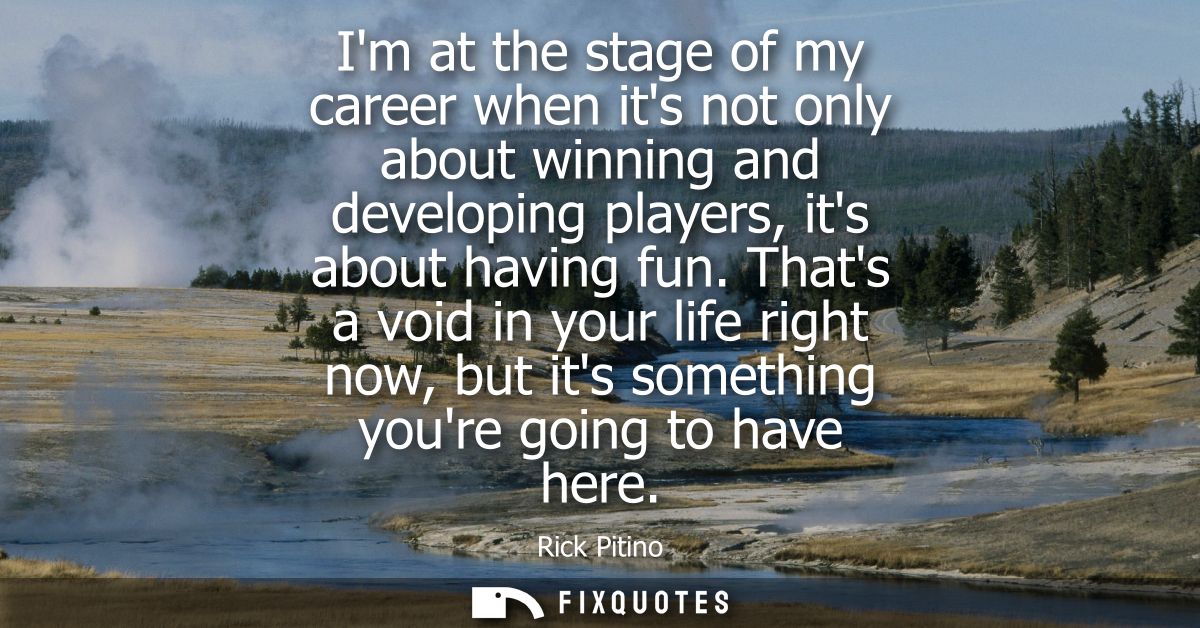
"I'm at the stage of my career when it's not only about winning and developing players, it's about having fun. That's a void in your life right now, but it's something you're going to have here"
About this Quote
A lifetime spent chasing banners and molding rosters gives this line its weight. Rick Pitino has lived the extremes of big-time basketball: national titles, NBA detours, rebuilds, exiles, and returns. When he says it is not only about winning and developing players, he is not walking away from standards; he is expanding the definition of a successful program. Results and growth remain nonnegotiable, but they are no longer sufficient. A team that meets its goals without joy still leaves something hollow.
The second sentence is the persuasive pivot. Telling a young player, That is a void in your life right now, is equal parts diagnosis and invitation. The contemporary college landscape can squeeze the joy out of the game: transfer churn, pro expectations, social media scrutiny, the constant transaction of NIL and exposure. Practices become obligations, not obsessions. Pitino frames his program as the antidote: here, the daily work will feel alive again. He is selling culture, not just minutes and stats.
Fun here is not frivolity. It comes from clarity of roles, shared purpose, honest accountability, and the permission to play with freedom because the preparation has been ruthless. Veteran coaches learn that joy is a competitive advantage: connected teams defend longer, cut harder, and survive February slumps. It also sustains development, because players embrace hard feedback when the environment gives back energy and belonging.
There is autobiography in the subtext. After triumphs and turbulence, a coach in the later chapters is curating his legacy as much as his offense. He wants a room that competes and laughs, a season measured by memories as well as metrics. Saying it aloud is a statement of confidence: winning and fun are not opposites but allies. It is also a quiet confession about the profession itself. Without joy, even the victories leave a void. The promise is that here, the game gives back what the grind can take away.
The second sentence is the persuasive pivot. Telling a young player, That is a void in your life right now, is equal parts diagnosis and invitation. The contemporary college landscape can squeeze the joy out of the game: transfer churn, pro expectations, social media scrutiny, the constant transaction of NIL and exposure. Practices become obligations, not obsessions. Pitino frames his program as the antidote: here, the daily work will feel alive again. He is selling culture, not just minutes and stats.
Fun here is not frivolity. It comes from clarity of roles, shared purpose, honest accountability, and the permission to play with freedom because the preparation has been ruthless. Veteran coaches learn that joy is a competitive advantage: connected teams defend longer, cut harder, and survive February slumps. It also sustains development, because players embrace hard feedback when the environment gives back energy and belonging.
There is autobiography in the subtext. After triumphs and turbulence, a coach in the later chapters is curating his legacy as much as his offense. He wants a room that competes and laughs, a season measured by memories as well as metrics. Saying it aloud is a statement of confidence: winning and fun are not opposites but allies. It is also a quiet confession about the profession itself. Without joy, even the victories leave a void. The promise is that here, the game gives back what the grind can take away.
Quote Details
| Topic | Work-Life Balance |
|---|
More Quotes by Rick
Add to List