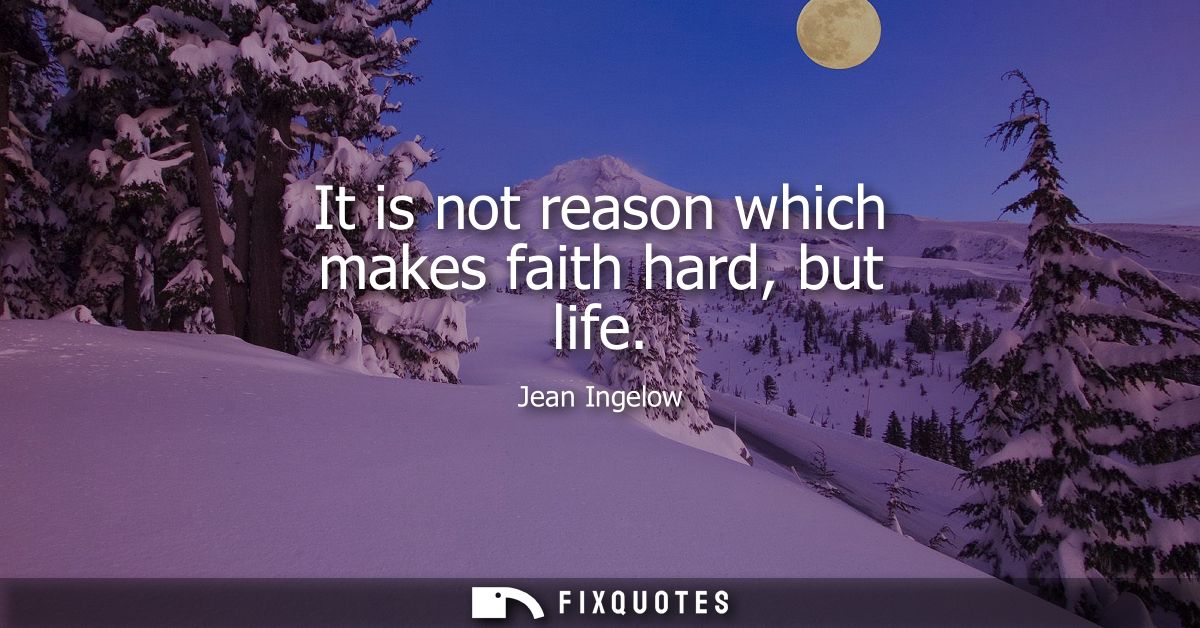
"It is not reason which makes faith hard, but life"
About this Quote
Reason is not the enemy of faith; life is. Jean Ingelow distills a tension common to the Victorian world she inhabited, a time when scientific discovery, biblical criticism, and philosophical doubt were often blamed for eroding belief. She points elsewhere. Abstract arguments can be debated, reconciled, or accommodated within a thoughtful theology. Lived experience, with its griefs, injustices, disappointments, and daily grind, places the deeper strain on trust. Faith, in this sense, is not mere assent to propositions but sustained reliance in the face of what feels senseless or cruel.
The claim is psychologically shrewd. When tragedy strikes, when prayers seem unanswered, when the good suffer and the wicked prosper, confidence in a benevolent order falters. Reason may propose explanations, but the heart wrestles with immediate wounds. The problem is not the clarity of ideas but the opacity of events. Faith must go on living alongside illness, loss, monotony, and the quiet erasures of time; that endurance is where the difficulty lies.
Ingelow’s work often turns to ordinary lives and weather, tides, and seasons as emblems of uncontrollable forces. Her famous poem High Tide on the Coast of Lincolnshire evokes communal peril and the precariousness of safety. The spiritual question there is not whether belief can be argued, but whether it can abide while waters rise. That angle reframes debates about belief: skepticism is not only born in lecture halls but also in bedrooms, kitchens, and fields, where hopes are deferred and outcomes feel arbitrary.
There is also an implicit charity toward reason. By refusing to cast intellect as the main adversary, Ingelow suggests that a reflective mind need not be hostile to faith. The harder work is existential, not logical: to keep trusting while living. The line becomes both diagnosis and quiet encouragement, recognizing that the trial of belief is less a matter of syllogisms than of steadfastness through the wear and tear of days.
The claim is psychologically shrewd. When tragedy strikes, when prayers seem unanswered, when the good suffer and the wicked prosper, confidence in a benevolent order falters. Reason may propose explanations, but the heart wrestles with immediate wounds. The problem is not the clarity of ideas but the opacity of events. Faith must go on living alongside illness, loss, monotony, and the quiet erasures of time; that endurance is where the difficulty lies.
Ingelow’s work often turns to ordinary lives and weather, tides, and seasons as emblems of uncontrollable forces. Her famous poem High Tide on the Coast of Lincolnshire evokes communal peril and the precariousness of safety. The spiritual question there is not whether belief can be argued, but whether it can abide while waters rise. That angle reframes debates about belief: skepticism is not only born in lecture halls but also in bedrooms, kitchens, and fields, where hopes are deferred and outcomes feel arbitrary.
There is also an implicit charity toward reason. By refusing to cast intellect as the main adversary, Ingelow suggests that a reflective mind need not be hostile to faith. The harder work is existential, not logical: to keep trusting while living. The line becomes both diagnosis and quiet encouragement, recognizing that the trial of belief is less a matter of syllogisms than of steadfastness through the wear and tear of days.
Quote Details
| Topic | Faith |
|---|
More Quotes by Jean
Add to List