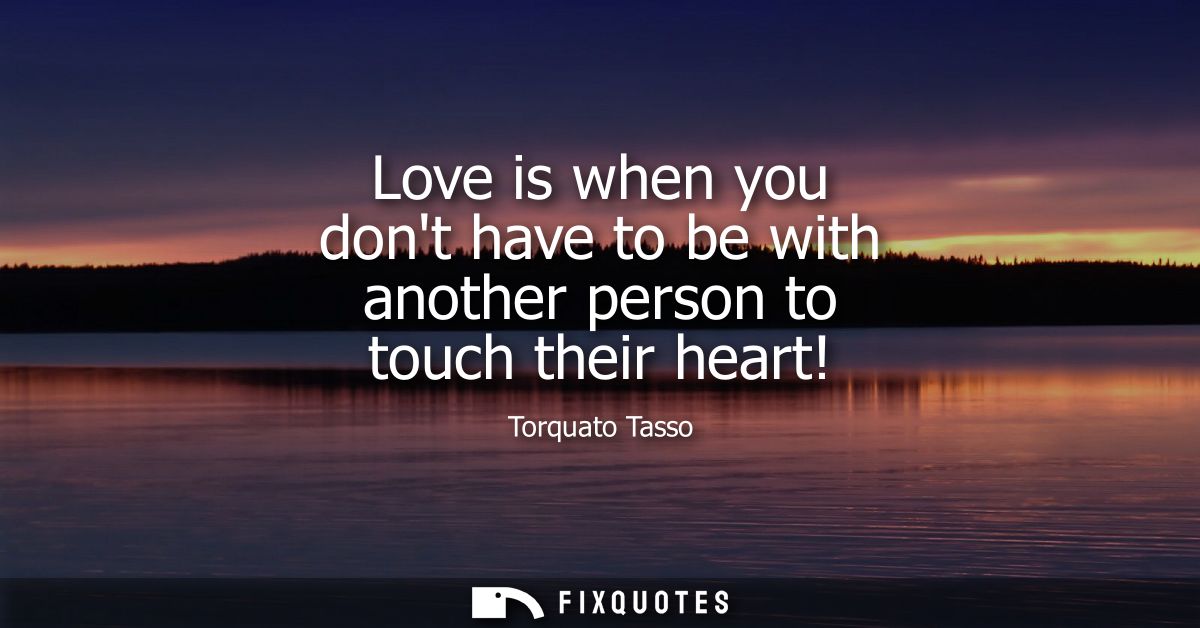
"Love is when you don't have to be with another person to touch their heart!"
About this Quote
Tasso’s line makes love sound less like possession and more like transmission: an influence that can travel without bodies in the same room. In a Renaissance culture that treated love as both a social contract and a moral hazard, the claim is quietly radical. It elevates the interior life over the visible one, insisting that the most decisive contact is not physical proximity but emotional reach.
The verb choice is the tell. “Touch their heart” borrows the language of touch while refusing touch’s literal conditions. It’s a poetic sleight of hand that sanctifies absence: distance becomes not a deficit but a proof of depth. That fits a poet steeped in courtly tradition, where longing, idealization, and the choreography of separation often mattered more than consummation. Love, in this worldview, is a discipline of attention - the ability to move someone through memory, language, reputation, prayer.
The subtext also reads as self-justification. Tasso’s life was marked by instability, patronage politics, and confinement; an imagination trained to survive dislocation would naturally prize bonds that don’t require access. The line reassures the lover (and the poet) that connection can outlast gates, rules, and geography. It’s not anti-physical so much as anti-reductive: if love only “counts” when it’s embodied, then power and circumstance get to decide who gets to love.
What makes it work is its paradox: it demotes presence without denying intimacy, making the heart the real meeting place.
The verb choice is the tell. “Touch their heart” borrows the language of touch while refusing touch’s literal conditions. It’s a poetic sleight of hand that sanctifies absence: distance becomes not a deficit but a proof of depth. That fits a poet steeped in courtly tradition, where longing, idealization, and the choreography of separation often mattered more than consummation. Love, in this worldview, is a discipline of attention - the ability to move someone through memory, language, reputation, prayer.
The subtext also reads as self-justification. Tasso’s life was marked by instability, patronage politics, and confinement; an imagination trained to survive dislocation would naturally prize bonds that don’t require access. The line reassures the lover (and the poet) that connection can outlast gates, rules, and geography. It’s not anti-physical so much as anti-reductive: if love only “counts” when it’s embodied, then power and circumstance get to decide who gets to love.
What makes it work is its paradox: it demotes presence without denying intimacy, making the heart the real meeting place.
Quote Details
| Topic | Love |
|---|
More Quotes by Torquato
Add to List