
Pericles Biography Quotes 14 Report mistakes
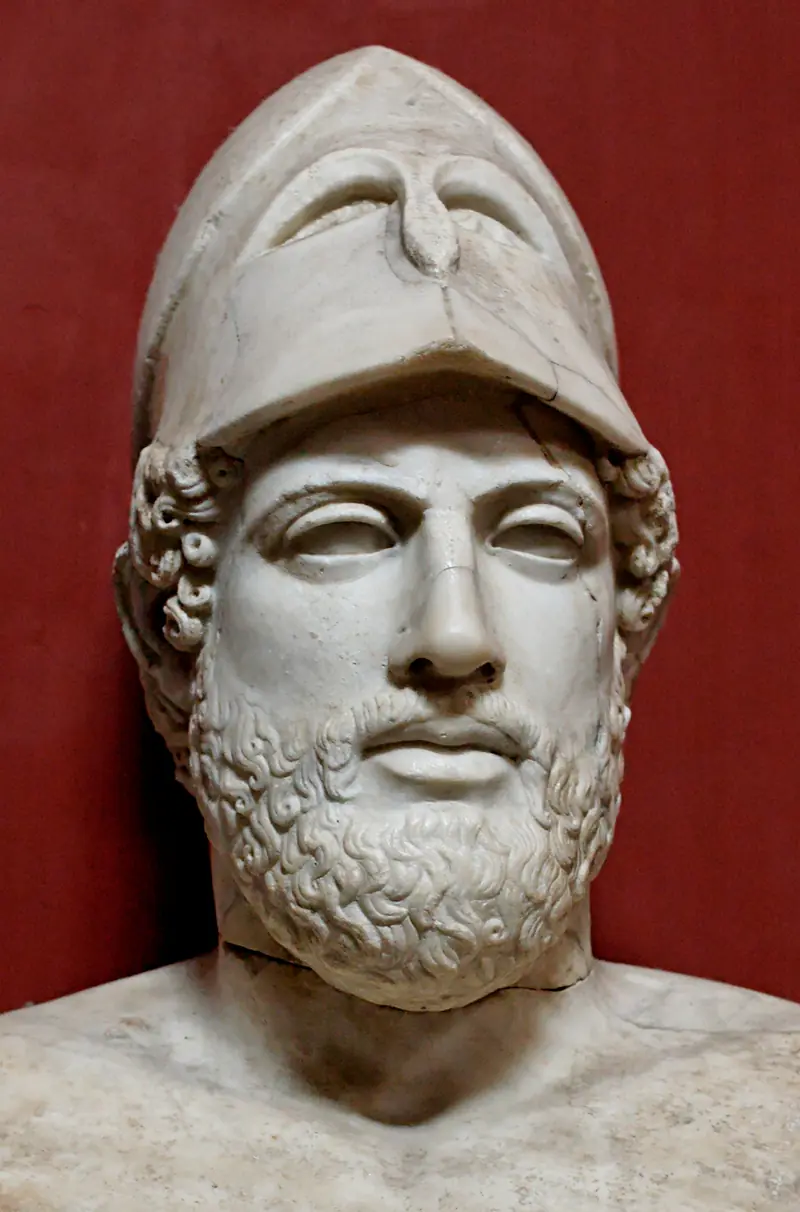
Attr: Vatican Museums
| 14 Quotes | |
| Occup. | Statesman |
| From | Greece |
| Born | 495 BC Athens, Greece |
| Died | 429 BC Athens, Greece |
Pericles was born around 495 BCE into a prominent Athenian family. His father, Xanthippus, was an influential politician and general associated with victories in the Persian Wars, and his mother, Agariste, came from the Alcmaeonid clan, which linked Pericles to earlier reformers such as Cleisthenes. This lineage gave him both social standing and a political inheritance in a city that, after defeating Persia, was rapidly redefining its institutions and projecting power across the Aegean. Educated in the arts of music, rhetoric, and philosophy, he reportedly moved in intellectual circles that prized reason and disciplined argument. Later writers associated him with the philosopher Anaxagoras, whose emphasis on natural explanations and rational inquiry was said to influence Pericles' calm style and measured public demeanor.
Entry into Athenian Politics
Pericles emerged on the political stage in the 460s BCE, a decade shaped by fierce debates over the balance of power among Athenian institutions. He was connected to a movement associated with Ephialtes that curtailed the authority of the Areopagus, redistributing powers toward the Assembly, the popular courts, and the Council. In this contest he opposed figures such as Cimon, a celebrated general who favored cooperation with Sparta and the prestige of the older aristocratic councils. After Cimon was ostracized, Pericles' influence grew, though he continued to face organized opposition, notably from Thucydides son of Melesias, who tried to marshal elite discontent against him. Their rivalry ended with Thucydides' ostracism, leaving Pericles as the most persuasive voice among the elected generals.
Democratic Reforms and Leadership Style
Although Athens' democracy had deep roots, Pericles helped stabilize and extend it. He was repeatedly elected strategos, or general, a role that combined military command with policy leadership. Under his influence, Athens adopted measures that expanded civic participation, including stipends that enabled poorer citizens to serve on juries and in other civic capacities. A citizenship law associated with Pericles tightened the requirements for citizenship to those born of two Athenian parents, a change that reflected anxieties about identity in an expanding empire. Throughout, Pericles cultivated a leadership style built on persuasion rather than personal patronage. The historian Thucydides, writing soon after these events, judged him a leader who guided the people rather than being led by them, crediting him with long-term thinking and a refusal to court popularity at the expense of strategy.
Cultural Patronage and Building Program
Pericles became closely identified with a burst of cultural and architectural activity that transformed Athens. He championed rebuilding the Acropolis and associated works after the Persian sack, supporting a building program that conveyed the city's wealth and confidence. The Parthenon rose as a symbol of Athenian power and devotion, while the Propylaea and other structures reshaped the sacred skyline. The sculptor Phidias, a close associate, oversaw aspects of the artistic vision, and his work became emblematic of classical form. Festivals flourished, and drama by poets such as Aeschylus, Sophocles, and Euripides found attentive audiences in theaters supported by civic funds. This cultural flowering was not merely ornamental; it was presented as an expression of the civic values Pericles praised in his speeches, where he defended the openness, education, and public spirit of the city.
Alliances, Empire, and Policy Abroad
Abroad, Athens led the Delian League, originally an alliance against Persia that over time became an Athenian maritime empire. Member states paid contributions that supported the fleet and, increasingly, Athenian projects at home. At some point the treasury of the League was transferred to Athens from Delos, a move that symbolized the shift from partnership to hegemony. Pericles supported establishing cleruchies, settlements of Athenian citizens in allied territories, which helped secure strategic points and control tribute routes. He also led military operations, including the protracted conflict with Samos, where a revolt was suppressed after a difficult siege. These actions reinforced Athenian dominance but hardened resentment among other Greek states, particularly those aligned with Sparta, which watched with growing alarm as Athens leveraged naval power and resources.
War with Sparta and Strategic Vision
Tensions culminated in the Peloponnesian War, which began in 431 BCE. As Spartan-led forces invaded Attica, Pericles advocated a defensive strategy on land, declining pitched battle against superior Spartan infantry while relying on the fleet to raid enemy coasts and protect supply lines. This approach leveraged the Long Walls that linked Athens to its port at Piraeus, allowing the city to survive sieges and maintain access to the sea. Pericles warned against expansionist adventures that could overextend Athenian power. The strategy was costly and required discipline, particularly for rural Athenians who had to abandon their farms for the safety of the city. Early in the war he delivered the Funeral Oration, recorded by Thucydides, which praised the citys openness, innovation, and willingness to sacrifice. The speech remains a central document of classical political thought and an articulation of how Athenians wished to see themselves.
Personal Life and Circle
Pericles' private life attracted public scrutiny. He separated from his first wife by mutual agreement, a rare act handled through legal procedures of the time. Their sons, Xanthippus and Paralus, were known in the city, and their later deaths in the plague were a personal tragedy. Pericles formed a lasting partnership with Aspasia of Miletus, whose intelligence and rhetorical skill were noted by contemporaries and later writers. Their relationship was controversial in political and comic circles, and Aspasia herself became the subject of attacks, but she appears to have been an important interlocutor in Pericles' household. His intellectual companions included Anaxagoras, who came under pressure for impiety, and Phidias, who faced accusations related to the use of materials for the Acropolis statues. Political opponents used such charges to weaken Pericles' standing, though the extent and motives of these prosecutions are debated in the sources.
Plague, Death, and Immediate Aftermath
The outbreak of plague in 430 BCE devastated Athens, a catastrophe intensified by the very strategy that concentrated population within the walls. A second wave followed, and the disease did not discriminate among ranks or talents. Pericles himself fell ill and died in 429 BCE. His death coincided with a period of uncertainty in policy, as the city lurched between bold offensives and uneasy truces under successors such as Cleon and, later, Nicias. Thucydides contrasted Pericles' disciplined approach with the more volatile politics that followed, arguing that after his passing the city was more susceptible to short-term pressures and demagogic appeals. The war would continue for decades and ultimately end in Athenian defeat, leaving later generations to ponder whether Pericles' strategy would have prevailed had he lived longer, or whether the empire he helped build had already set conditions for the citys eventual fall.
Reputation, Assessments, and Sources
Pericles' reputation has been shaped by two main strands of testimony. Thucydides, who served as a general later in the war, offered a relatively austere but admiring assessment, emphasizing prudence, foresight, and integrity. Plutarch, writing centuries later, portrayed a more rounded character, collecting anecdotes about Pericles' reserve in public, his care in speech, and the attacks from rivals who resented his standing. Comic poets caricatured him as aloof or overbearing, a figure whose policies burdened allies and stirred conflict. Modern readers weigh these voices alongside inscriptions, building accounts, and the material legacy of the Acropolis. Whatever the verdict on particular decisions, the contours of his career are clear: he stood at the center of Athenian life at a moment when democracy, naval power, artistic achievement, and imperial ambition were tightly intertwined. The circle around him, from political allies such as Ephialtes to rivals like Cimon and Thucydides son of Melesias, from the artist Phidias to his companion Aspasia and the philosopher Anaxagoras, makes visible the networks that sustained and contested his leadership. His era remains a reference point for discussions of civic participation, cultural patronage, and the limits of power in a fragile international system.
Our collection contains 14 quotes who is written by Pericles, under the main topics: Wisdom - Leadership - Freedom - Legacy & Remembrance - Mortality.
Other people realated to Pericles: Herodotus (Historian), Themistocles (Soldier), Walter Savage Landor (Poet), Aristophanes (Poet), Protagoras (Philosopher), Donald Kagan (Historian)
Source / external links