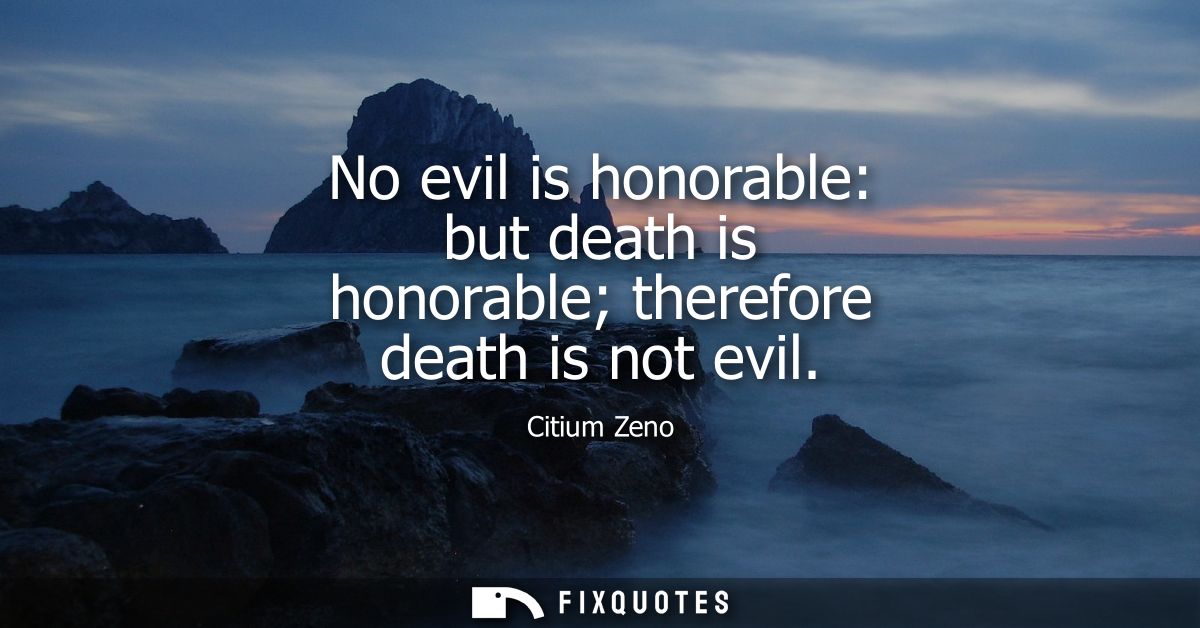
"No evil is honorable: but death is honorable; therefore death is not evil"
About this Quote
Stoic logic here lands like a clean blade: if you accept one premise, you are forced to swallow the conclusion, even if your instincts resist it. Zeno builds a tight little syllogism that doubles as psychological training. “Evil” is defined not as anything painful, frightening, or unwanted, but as something morally shameful. Then he drops the provocation: death, in the right posture, can be “honorable” - meaning it can be faced with integrity, chosen over corruption, or endured without moral collapse. If honor is possible in death, death can’t be evil in the Stoic sense. The trick isn’t rhetorical flourish; it’s reclassification.
The subtext is a quiet assault on the culture of dread. In Athens and across the Hellenistic world, death was the ultimate lever: tyrants threatened it, crowds demanded it, families feared it, and gods were invoked around it. Zeno’s move strips that lever of power. If death is not evil, it cannot be used to blackmail you into betrayal, cowardice, or self-erasure. It becomes an “indifferent” - not nothing, not trivial, but not the thing that determines your worth.
Context matters: early Stoicism was forged amid political volatility and personal precariousness. For Zeno, philosophy isn’t a parlor sport; it’s a discipline for staying free when everything external can be taken. The line is meant to harden the spine: fear of death is often fear of losing control, status, narrative. Stoicism answers by relocating value to the only territory that can’t be conquered: character.
The subtext is a quiet assault on the culture of dread. In Athens and across the Hellenistic world, death was the ultimate lever: tyrants threatened it, crowds demanded it, families feared it, and gods were invoked around it. Zeno’s move strips that lever of power. If death is not evil, it cannot be used to blackmail you into betrayal, cowardice, or self-erasure. It becomes an “indifferent” - not nothing, not trivial, but not the thing that determines your worth.
Context matters: early Stoicism was forged amid political volatility and personal precariousness. For Zeno, philosophy isn’t a parlor sport; it’s a discipline for staying free when everything external can be taken. The line is meant to harden the spine: fear of death is often fear of losing control, status, narrative. Stoicism answers by relocating value to the only territory that can’t be conquered: character.
Quote Details
| Topic | Ethics & Morality |
|---|---|
| Source | Help us find the source |
More Quotes by Citium
Add to List