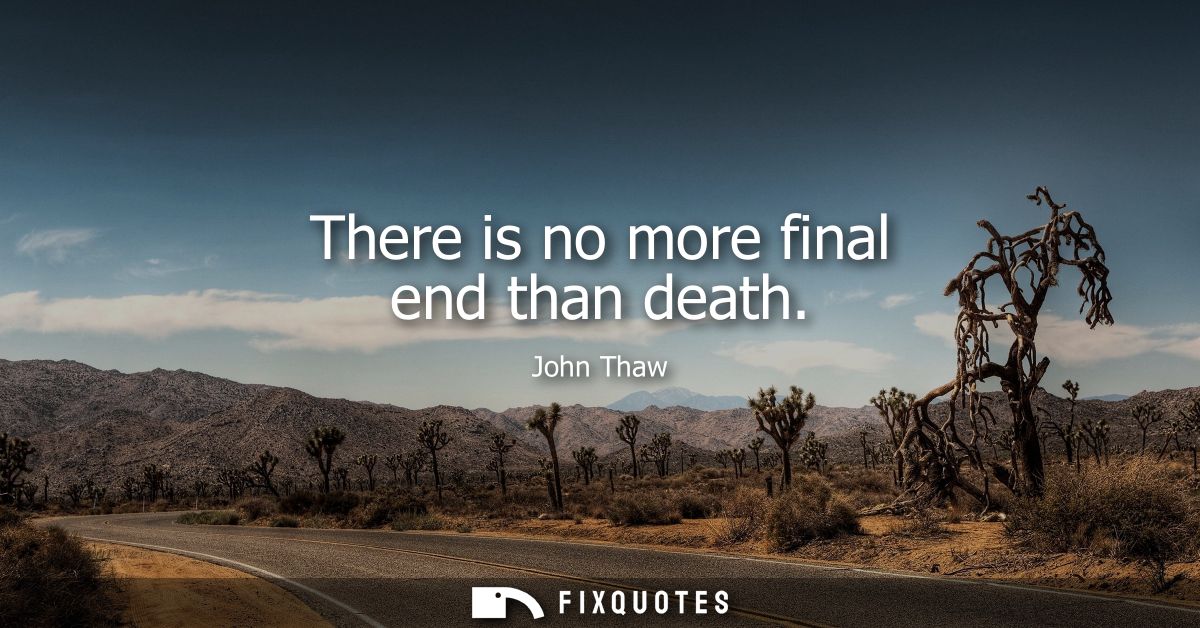
"There is no more final end than death"
About this Quote
“There is no more final end than death” lands like a line delivered with a steady gaze: plain words, heavy consequence. Coming from John Thaw, an actor best known for embodying hard-edged, morally alert men (Inspector Morse’s weary intelligence, for one), the phrasing feels less like poetry than like a verdict. The power is in its refusal to decorate. “Final” is redundant with “end,” yet that redundancy is the point: it mimics the mind looping around the one certainty it can’t out-argue.
The intent reads as a corrective to our everyday euphemisms. We talk around death - “passing,” “moving on,” “closure” - as if language can sand down the terror. Thaw’s sentence strips that away and insists on the blunt hierarchy of consequences. Whatever else you can recover from - scandal, heartbreak, even illness - death is the boundary that doesn’t negotiate.
Subtextually, it’s also a comment on control. Actors live in repetition: multiple takes, reshoots, alternate endings. Life rarely grants that luxury, and death absolutely doesn’t. The line pushes back against the modern fantasy of endless second chances, self-reinvention, or legacy as immortality. It doesn’t mock those comforts; it quietly denies their jurisdiction.
Context matters, too. Thaw’s generation grew up in the long shadow of war and lived through an era when public stoicism was prized. Read that way, the quote isn’t melodrama. It’s a bracing, almost procedural realism: you can postpone, you can distract, you can narrate, but you can’t out-end the end.
The intent reads as a corrective to our everyday euphemisms. We talk around death - “passing,” “moving on,” “closure” - as if language can sand down the terror. Thaw’s sentence strips that away and insists on the blunt hierarchy of consequences. Whatever else you can recover from - scandal, heartbreak, even illness - death is the boundary that doesn’t negotiate.
Subtextually, it’s also a comment on control. Actors live in repetition: multiple takes, reshoots, alternate endings. Life rarely grants that luxury, and death absolutely doesn’t. The line pushes back against the modern fantasy of endless second chances, self-reinvention, or legacy as immortality. It doesn’t mock those comforts; it quietly denies their jurisdiction.
Context matters, too. Thaw’s generation grew up in the long shadow of war and lived through an era when public stoicism was prized. Read that way, the quote isn’t melodrama. It’s a bracing, almost procedural realism: you can postpone, you can distract, you can narrate, but you can’t out-end the end.
Quote Details
| Topic | Mortality |
|---|---|
| Source | Help us find the source |
| Cite |
Citation Formats
APA Style (7th ed.)
Thaw, John. (2026, January 15). There is no more final end than death. FixQuotes. https://fixquotes.com/quotes/there-is-no-more-final-end-than-death-153635/
Chicago Style
Thaw, John. "There is no more final end than death." FixQuotes. January 15, 2026. https://fixquotes.com/quotes/there-is-no-more-final-end-than-death-153635/.
MLA Style (9th ed.)
"There is no more final end than death." FixQuotes, 15 Jan. 2026, https://fixquotes.com/quotes/there-is-no-more-final-end-than-death-153635/. Accessed 12 Feb. 2026.
More Quotes by John
Add to List