
Alexander Pope Biography Quotes 89 Report mistakes
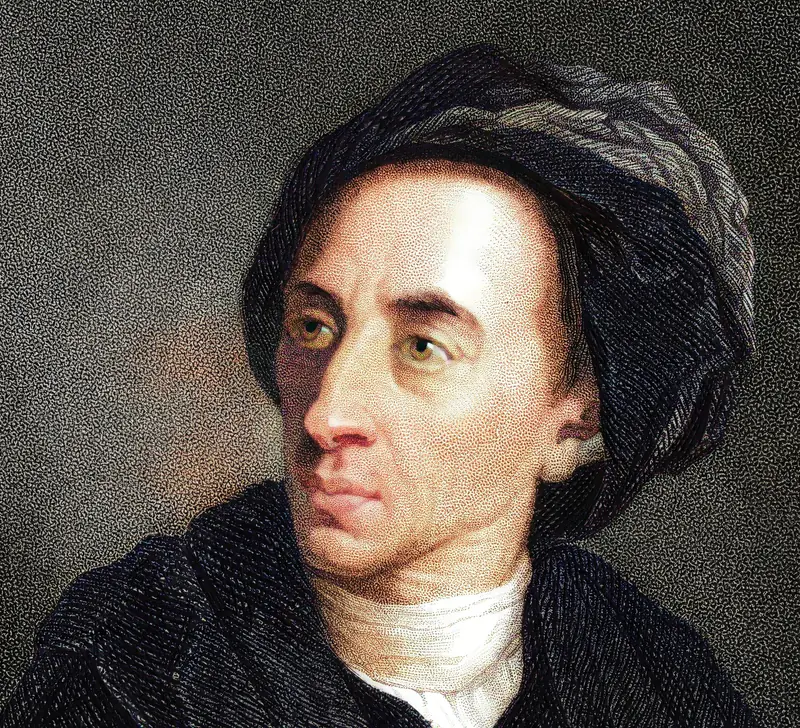
| 89 Quotes | |
| Occup. | Poet |
| From | England |
| Born | May 21, 1688 England |
| Died | May 30, 1744 England |
| Aged | 56 years |
Alexander Pope was born on May 21, 1688, in London, the year of the Glorious Revolution that confirmed a Protestant settlement and sharpened the legal penalties on Catholics. His parents were Roman Catholic; his father, also named Alexander, prospered in the linen trade, and his mother, Edith Turner, came from a recusant family. That status shaped Pope from the start: barred from universities and many professions, he grew up alert to exclusion, the power of institutions, and the art of maneuvering within hostile structures.
Ill health made those pressures intimate. As a child he suffered a spinal disease, likely Pott's disease, that stunted his growth and left him in chronic pain. The body he could not master became the furnace of his ambition: he learned to treat the page as a space where strength could be manufactured, attacks could be parried, and weakness could be transmuted into authority. When anti-Catholic restrictions tightened, the family moved to Binfield in Windsor Forest, a semi-rural pocket close enough to London to keep the literary world within reach but far enough to foster the solitude that fed his obsessive craft.
Education and Formative Influences
Pope was largely self-taught, educated in fragments by Catholic tutors and then by his own systematic reading. He absorbed Latin from the poets he adored - Virgil, Ovid, Horace - and apprenticed himself to English models, especially Dryden, whose couplets taught him compression and music. Binfield gave him books, a garden, and long walks; London offered coffeehouse talk, patronage networks, and the early lesson that reputation could be built or wrecked by a line. Precocious, he began composing as a teenager, training his ear on heroic couplets until they became his instrument for both beauty and control.
Career, Major Works, and Turning Points
Pope's rise began with "Pastorals" (1709) and the dazzling "Essay on Criticism" (1711), which announced not only technical mastery but a desire to legislate taste. Fame widened with "The Rape of the Lock" (first version 1712, expanded 1714), a high-wire comic epic that turned a minor quarrel among Catholic gentry into a polished anatomy of vanity and social ritual. He joined the Scriblerus circle with Swift, Gay, and Arbuthnot, sharpening satire into a collective weapon against pedantry and political corruption. Financial independence came through his translation of Homer: the "Iliad" (1715-1720) and "Odyssey" (1725-1726, with collaborators), projects that made him a wealthy author in an age still dominated by patronage. The 1720s and 1730s brought a darker Pope: "The Dunciad" (1728; enlarged 1743) waged war on hacks and complacent learning; "Essay on Man" (1733-1734) aimed at philosophical consolation; and the "Imitations of Horace", along with "An Epistle to Dr. Arbuthnot" (1735), fused self-defense with moral diagnosis. In later years he retreated to Twickenham, building his famous grotto and garden while remaining a vigilant strategist of print and friendship until his death on May 30, 1744.
Philosophy, Style, and Themes
Pope's style is the English heroic couplet at its most engineered - symmetrical, epigrammatic, and relentlessly revised. He pursued what he understood as Augustan clarity: not the absence of passion, but passion disciplined into form, so that wit could pass for reason and reason could carry emotional force. His themes turn on measure: the measured line, the measured self, the measured society. In "Essay on Criticism" and the later moral epistles, he treats taste and ethics as related skills - both require humility before tradition and vigilance against self-deception. "Be not the first by whom the new are tried, Nor yet the last to lay the old aside". The sentence is not mere conservatism; it is Pope's psychological survival tactic, learned as an outsider who could not afford reckless novelty yet refused intellectual stagnation.
At his deepest, Pope is a poet of order haunted by disorder. The physical vulnerability of his life, and the volatility of the public sphere he inhabited, made him long for a cosmos where meaning could be argued into place. "Order is heaven's first law". That maxim, voiced in "Essay on Man", is both metaphysics and self-soothing: the pain-ridden body and the scandal-driven culture are folded into a providential pattern, not because experience proves it, but because the mind needs it. Yet he was no simple dogmatist; his satire depends on skepticism about expertise and the fragility of consensus. "Who shall decide when doctors disagree, And soundest casuists doubt, like you and me?" The question exposes a central tension in his inner life: he craved settled principles, but his intelligence kept uncovering the quarrels and motives beneath every claim to authority.
Legacy and Influence
Pope became the defining English poet of the early 18th century and, for generations, the standard of what polished verse could do: condense argument, sharpen social observation, and turn moral reflection into memorable music. He helped professionalize authorship through the Homer subscriptions, showing that a writer could negotiate with the market without surrendering to it, and his battles over piracy and plagiarism foreshadowed modern literary property. Later Romantics attacked his "artificial" couplets, yet even their rebellion testified to his centrality; meanwhile, satirists from Byron to modern political verse inherit his lesson that style is a weapon and that public life can be anatomized line by line. Pope's enduring influence lies in this double achievement: he made order seductive, and he made the struggle to maintain it visible.
Our collection contains 89 quotes who is written by Alexander, under the main topics: Witty One-Liners - Ethics & Morality - Wisdom - Truth - Justice.
Other people realated to Alexander: Jonathan Swift (Writer), Matthew Prior (Poet), William Warburton (Critic), Mary Wortley Montagu (Writer), John Denham (Politician), Edmund Waller (Poet), Robert Walpole (Statesman), William Wycherley (Dramatist), Lord Chandos (Writer), Richard Savage (Poet)
Alexander Pope Famous Works
- 1733 An Essay on Man (Poem)
- 1728 The Dunciad (Mock-Heroic Narrative Poem)
- 1725 The Works of Shakespear (Edited Works)
- 1717 Eloisa to Abelard (Epistolary Poem)
- 1712 The Rape of the Lock (Mock-Heroic Narrative Poem)
- 1711 An Essay on Criticism (Poem)
Source / external links