
Walt Whitman Biography Quotes 66 Report mistakes
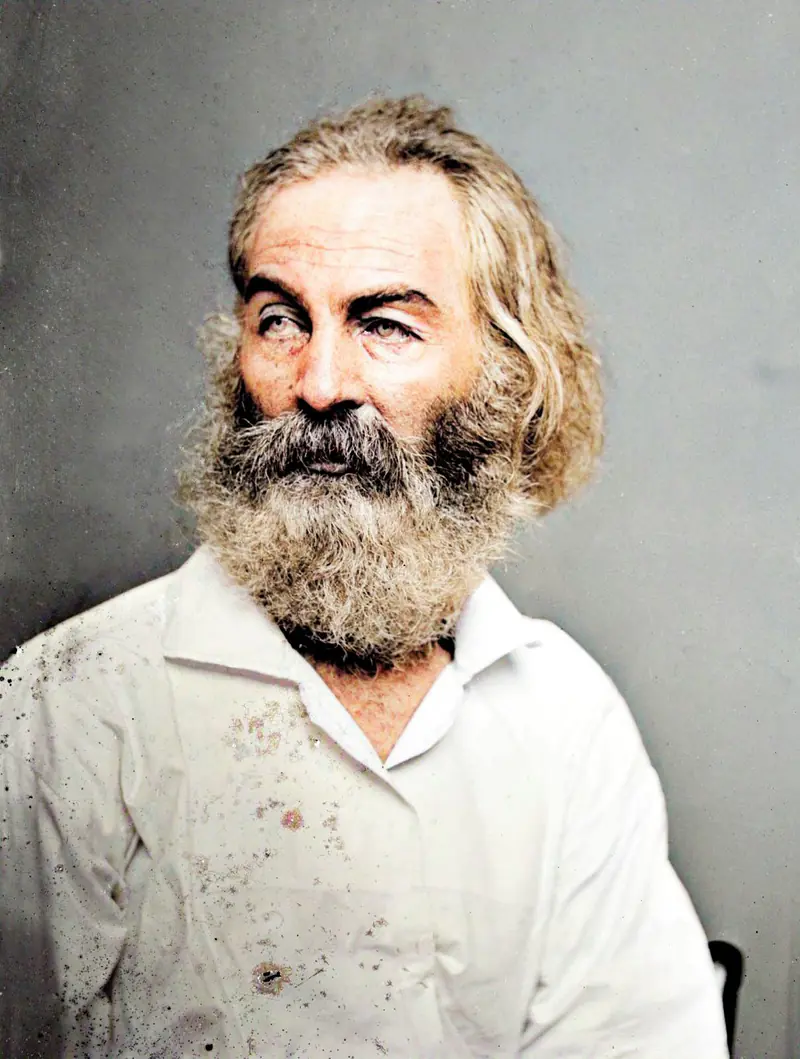
| 66 Quotes | |
| Born as | Walter Whitman Jr. |
| Occup. | Poet |
| From | USA |
| Born | May 31, 1819 West Hills, New York, U.S. |
| Died | March 26, 1892 Camden, New Jersey, U.S. |
| Aged | 72 years |
Walter Whitman Jr., known to the world as Walt Whitman, was born on May 31, 1819, in West Hills, Long Island, New York, into a large family headed by Walter Whitman Sr., a carpenter, and Louisa Van Velsor Whitman. His parents moved the children to the growing city of Brooklyn when he was a boy, and the bustling streets, ferries, and shipyards of New York Harbor became part of his earliest imaginative landscape. He left formal schooling young and apprenticed in printing offices, setting type and learning the craft that would later prove essential when he came to publish his own work. Immersed in newspapers and books, he absorbed the ferment of Jacksonian democracy, the rhythms of labor and urban life, and the broad promise of a continental republic.
Apprentice, Teacher, and Journalist
In his late teens and early twenties, Whitman taught in rural schools across Long Island, edited small-town papers, and wrote essays and sketches. He briefly returned to his birthplace to found the Long-Islander, then moved back to Brooklyn and New York journalism, where he developed a vigorous, plain-spoken prose style. As editor of the Brooklyn Daily Eagle in the mid-1840s, he promoted civic improvements and voiced free-soil sympathies. Dismissed over politics, he traveled to New Orleans in 1848 to work for the New Orleans Crescent, encountering the slave market there, an experience that deepened his national perspective. Back in Brooklyn he continued as a printer and editor, tried his hand at fiction with the temperance novel Franklin Evans, and began to conceive a new kind of American poetry.
Leaves of Grass and Poetic Innovation
In 1855 he self-published the first edition of Leaves of Grass in Brooklyn, a slim volume without the author's name on the title page, featuring a frontispiece portrait of a workingman-poet in open shirt and slouch hat. The free verse lines, candid sexuality, and democratic embrace startled readers. Ralph Waldo Emerson wrote to Whitman, hailing the book and greeting him "at the beginning of a great career"; Whitman boldly printed portions of that letter in later issues, a sign of both his gratitude and his instinct for self-promotion. The second and third editions added the passionate "Calamus" cluster and poems in which the poet's "I" merged with a visionary American "we". In Manhattan he moved among the bohemian circle at Pfaff's with Henry Clapp Jr. and Ada Clare, while in Brooklyn and New York he roamed the ferries and waterfront, absorbing the mingled life he sought to sing.
Civil War and Washington Years
The Civil War transformed Whitman's life and work. After learning that his brother George Washington Whitman had been wounded, he went south and soon settled in Washington, D.C., where he worked as a clerk and spent countless hours as a volunteer visitor and nurse in military hospitals. He brought fruit, tobacco, stationery, and a steadying presence to the wounded, and recorded scenes of suffering and devotion in notebooks that later informed Drum-Taps, Memoranda During the War, and Specimen Days. The assassination of Abraham Lincoln prompted two of his most enduring elegies, When Lilacs Last in the Dooryard Bloom'd and O Captain! My Captain! His federal clerkship briefly faltered when Secretary of the Interior James Harlan dismissed him over the alleged indecency of Leaves of Grass, but friends such as William Douglas O'Connor and John Burroughs helped secure another post. During these years Whitman formed close bonds, notably with Peter Doyle, a former streetcar conductor and veteran, and he welcomed visits from figures like Henry David Thoreau. The Washington period left him physically depleted but artistically enlarged, with a broadened compassion and a widened national canvas.
Camden Years and Final Works
In 1873 Whitman suffered a paralytic stroke and, after the death of his mother, moved to Camden, New Jersey, to live near his brother George. The setback limited his mobility, yet he continued to write, revise, and shape his life's work. He published Democratic Vistas, a searching meditation on the promises and failures of American democracy, and later collections and prose such as Two Rivulets and Specimen Days. Friends and admirers sustained him: the Canadian physician Richard Maurice Bucke wrote a biography; John Burroughs championed his poetry; Anne Gilchrist corresponded with him with ardent admiration; and Oscar Wilde visited him in 1882 and later recalled the meeting with vivid warmth. The 1881 Boston edition of Leaves of Grass drew official censure on grounds of obscenity; when the publisher withdrew under pressure, the Philadelphia publisher David McKay brought out the book, ensuring it remained available. In Camden he relied on a circle that included Horace Traubel and the lawyer Thomas Harned, who would later serve as literary executors, and Mary O. Davis, who kept his household. The artist Thomas Eakins photographed and painted him, creating images that matched the rugged public persona he had long cultivated.
Reputation and Legacy
Whitman spent his final decade refining the so-called "deathbed edition" of Leaves of Grass, determined that the book represent the sum of his vision. He lectured on Lincoln and received visitors at his modest house on Mickle Street, reflecting on a lifetime that had carried him from a printer's case in Brooklyn to a role as the self-declared poet of the body and the soul. He died in Camden on March 26, 1892, and was buried in a tomb he had planned at Harleigh Cemetery. His legacy rests on a radically inclusive poetics that broke with inherited meters, celebrated ordinary laborers and outcasts, and sought a national literature equal to a sprawling democracy. Contemporaries contested his frankness, but defenders like O'Connor, Burroughs, Bucke, and Traubel saw in him a new kind of American sage. Today his long-lined free verse, his intimate address to readers, and his insistence that a single life could contain multitudes continue to shape poetry and cultural thought across the United States and far beyond.
Our collection contains 66 quotes who is written by Walt, under the main topics: Motivational - Wisdom - Truth - Justice - Friendship.
Other people realated to Walt: Robert G. Ingersoll (Lawyer), Cesare Pavese (Poet), Carl Sandburg (Poet), Algernon Charles Swinburne (Poet), Harold Bloom (Critic), Galway Kinnell (Poet)
Walt Whitman Famous Works
- 1882 Specimen Days (Book)
- 1871 Democratic Vistas (Book)
- 1865 Drum-Taps (Book)
- 1855 Song of Myself (Poem)
- 1855 Leaves of Grass (Book)
Source / external links