
Dalai Lama Biography Quotes 51 Report mistakes
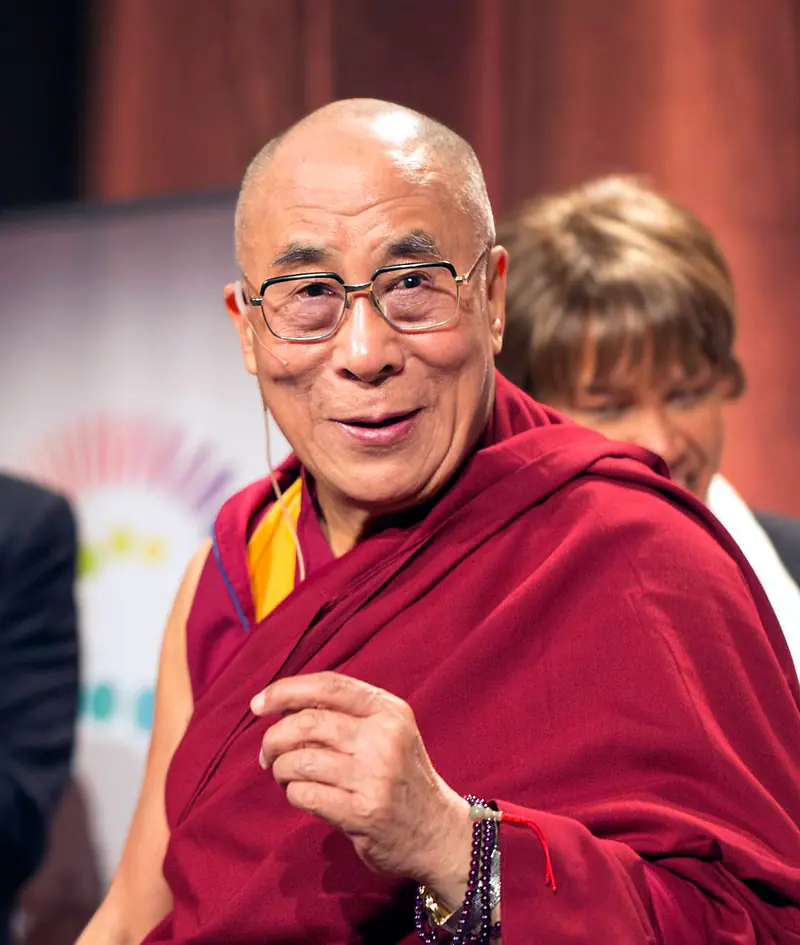
Attr: *christopher*, CC BY 2.0
| 51 Quotes | |
| Born as | Lhamo Thondup |
| Occup. | Leader |
| From | Tibet |
| Spouse | Tenzin Gyatso |
| Born | July 6, 1935 Taktser, Amdo, Tibet |
| Age | 90 years |
Lhamo Thondup was born on 1935-07-06 in Taktser, a village in Amdo (then on Tibet's northeastern cultural frontier, now in Qinghai), into a farming family whose life was shaped by altitude, barter economies, and the quiet authority of monasteries. His childhood unfolded in a Tibet where local identities - Amdo, Kham, U-Tsang - coexisted under the religious-political institution of the Ganden Phodrang, and where the search for the rebirth of the 13th Dalai Lama still governed national attention.
Recognized by a Tibetan search party as the 14th Dalai Lama, he was taken to Lhasa and installed in 1940, receiving the monastic name Tenzin Gyatso. The move from a household of animals and crops to the Potala Palace created an inner tension that would persist: a boy formed by ordinary rural intimacy, placed inside a sacral office that demanded serenity, ritual discipline, and symbolic perfection. Even early accounts emphasize his curiosity and warmth - traits that later became political tools as much as personal virtues in a century that would force him to speak to the world.
Education and Formative Influences
Educated as a Gelug monk, he trained in Buddhist philosophy, logic, metaphysics, and debate under senior tutors, absorbing the scholastic rigor that underpinned Tibetan governance. His formative years also coincided with the rise of the People's Republic of China and the transformation of Inner Asia after World War II; the collision between contemplative training and accelerating geopolitics produced a leader whose spiritual vocabulary would be tested against modern state power, propaganda, and the language of international law.
Career, Major Works, and Turning Points
In 1950, amid the advance of the People's Liberation Army, he assumed full political authority earlier than planned, meeting Chinese leaders including Mao Zedong in Beijing in 1954-55 while trying to preserve Tibetan autonomy. After the 1959 Lhasa uprising, he escaped across the Himalayas to India and established the Central Tibetan Administration in Dharamsala, initiating a long exile defined by refugee resettlement, monastic reconstruction, and global advocacy. Over decades he advanced the "Middle Way" approach - genuine autonomy for Tibet within China - while teaching worldwide, engaging scientists and ethicists, and authoring widely read works such as The Art of Happiness (with Howard Cutler) and Ethics for the New Millennium. In 1989 he received the Nobel Peace Prize, and in 2011 he formally devolved his political authority to an elected Tibetan leadership, reframing the Dalai Lama's role as primarily spiritual and cultural rather than governmental.
Philosophy, Style, and Themes
The core of his public philosophy is a translation of Buddhist compassion into a civic ethic that can speak to believers and secular audiences alike. His leadership style is notably disarming: humor, accessibility, and the habit of reasoning out loud, as if debate courtyard method could be applied to trauma and diplomacy. That method is also psychological self-defense - a disciplined way of not letting outrage dominate the mind. "If it can be solved, there's no need to worry, and if it can't be solved, worry is of no use". In his inner life, the sentence functions less like a slogan than a training instruction: reduce rumination, see conditions clearly, then act.
His themes return to moral agency under pressure: kindness as a practice, not a mood; responsibility as the price of freedom; and time as the only arena in which compassion becomes real. "There are only two days in the year that nothing can be done. One is called Yesterday and the other is called Tomorrow. Today is the right day to Love, Believe, Do and mostly Live". The insistence on today is also a leader's answer to exile - a refusal to let loss become identity. Yet he is equally clear that gentleness is not submission, especially for a people negotiating survival between empire and diaspora: "Don't ever mistake my silence for ignorance, my calmness for acceptance or my kindness for weakness. Compassion and tolerance are not a sign of weakness, but a sign of strength". The line reveals his balancing act - protecting the mind from hatred while keeping moral clarity sharp enough to confront coercion.
Legacy and Influence
The 14th Dalai Lama made Tibetan Buddhism a global moral language and turned a threatened plateau culture into a transnational community with schools, monasteries, and archives in exile. For supporters, he is the emblem of nonviolent resistance and interfaith bridge-building; for critics, his celebrity can oversimplify Tibet's complex history, and his Middle Way has drawn debate among Tibetans themselves. Still, his enduring influence lies in a rare synthesis: monastic discipline with modern media, metaphysical humility with political persistence, and a vision of compassion robust enough to survive defeat without surrendering dignity.
Our collection contains 51 quotes who is written by Dalai, under the main topics: Motivational - Ethics & Morality - Wisdom - Never Give Up - Friendship.
Other people realated to Dalai: Thomas Merton (Author), Martin Scorsese (Director), Daniel Goleman (Author), Tom Lantos (Diplomat), Arthur C. Brooks (Author), George Woodcock (Writer)
Dalai Lama Famous Works
- 2005 The Universe in a Single Atom: The Convergence of Science and Spirituality (Book)
- 2002 How to Practice: The Way to a Meaningful Life (Book)
- 1999 Ethics for the New Millennium (Book)
- 1998 The Art of Happiness (Book)
- 1990 Freedom in Exile: The Autobiography of the Dalai Lama (Book)
Source / external links